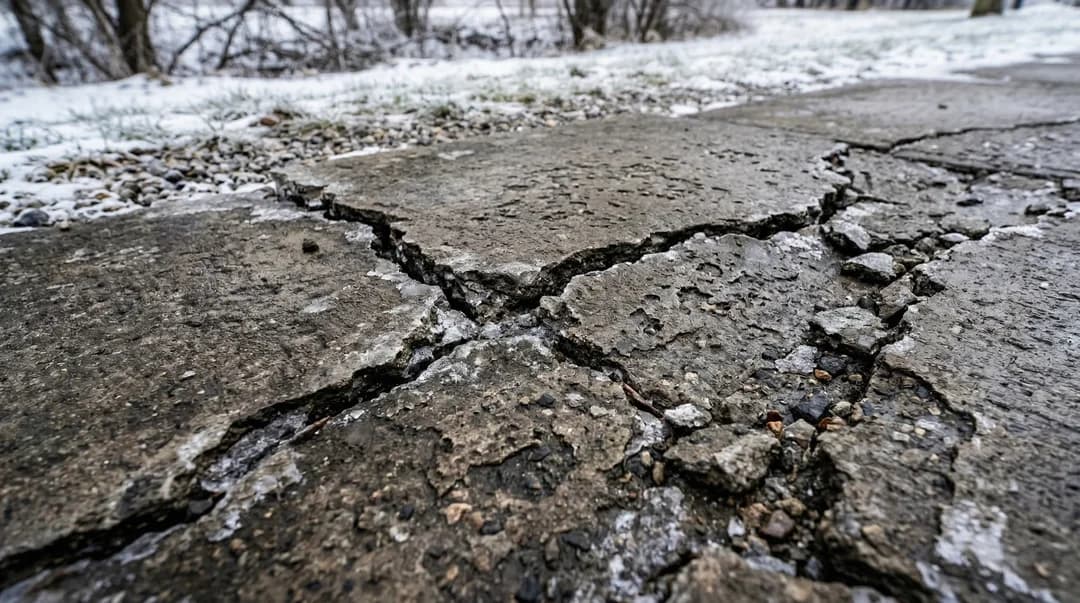
The Hidden Threat: Understanding Winter Concrete Damage
Homeowners and business owners in the Fraser Valley often discover severe winter concrete damage long after the cold season has passed. By the time spring arrives in cities like Chilliwack and Abbotsford, seemingly minor driveway fissures or foundation flaws have frequently evolved into major structural hazards. The primary culprit behind this delayed destruction is the continuous and punishing freeze-thaw cycle.
At its core, the freeze-thaw cycle is a natural mechanical weathering process where moisture infiltrates porous building materials, freezes when temperatures drop, and thaws as the weather warms. This simple sequence is highly destructive because water expands by approximately 9% when transitioning from a liquid to a solid state (National Institutes of Health, 'Mechanical properties and Freeze-Thaw durability of concrete'). Inside unprotected concrete, this volume expansion generates immense internal hydraulic pressure against the microscopic walls of the material's pores.
When this hydraulic pressure exceeds the concrete's natural tensile strength, microscopic fractures develop deep within the slab. Over multiple seasonal cycles, these internal fissures widen into substantial surface cracks, leading to concrete spalling, sunken walkways, and compromised foundation waterproofing. The financial scale of this structural threat is massive; in fact, the global concrete restoration market reached an estimated $12.9 billion in 2022, driven heavily by the urgent need to address freeze-thaw degradation in aging infrastructure (Transparency Market Research, 'Concrete Restoration Market Size'). Temporary, over-the-counter sealants simply cannot withstand this localized structural expansion and will inevitably fail.
For property managers and civil infrastructure leaders, standard DIY patches are insufficient against such relentless physical forces. This is where Black Birch Contracting steps in, offering premier Fraser Valley concrete crack repair services. Leveraging over 30 years of local experience, we provide specialized, long-lasting solutions tailored specifically to our region's wet and freezing climate. Whether you need the reliable concrete restoration Chilliwack residents trust, advanced polyurethane crack injection to permanently seal active foundation leaks, or structural soil stabilization via high-density polyfoam grouting, our engineering-grade methods ensure your property is fully protected against the hidden threat of winter concrete damage.
How Expanding Ice Causes Concrete Spalling and Structural Damage
To understand why driveways, patios, and foundation walls deteriorate so rapidly during the winter months, it is essential to look at the underlying physics of the freeze-thaw cycle. When rain, snowmelt, or ground moisture infiltrates the porous structure of a concrete slab, it sets the stage for severe winter concrete damage. As temperatures drop below freezing, this trapped water turns to ice and expands in volume by approximately 9% (National Ready Mixed Concrete Association, "Criteria for Freeze-Thaw Resistant Concrete Mixtures"). Because the hardened concrete matrix has no internal flexibility, this volumetric expansion generates immense hydraulic pressure that actively forces the material apart from the inside out.
When this internal pressure exceeds the material's natural tensile strength, the concrete matrix begins to rupture (Guo et al., "Damage Mechanism and Modeling of Concrete in Freeze–Thaw Cycles: A Review"). This physical weathering process directly causes concrete spalling, which is defined as the flaking, pitting, and crumbling of the concrete's surface layer that leaves the underlying aggregate and reinforcing steel fully exposed to the elements (National Institutes of Health, "The Freeze-Thaw Cycle in Concrete and Brick Assemblies"). Once the top protective layer breaks away, the slab becomes even more vulnerable, allowing a higher volume of moisture to seep deeper into the structural substrate.
This structural degradation is rarely a one-time event. Instead, the damage compounds rapidly as temperatures continually fluctuate:
Micro-Fracturing: Initial freezing creates microscopic fissures within the concrete capillaries.
Water Intrusion: During the thaw phase, liquid water flows freely into these newly formed micro-fractures.
Deep Structural Damage: The next freeze forces the expanding ice deeper, widening the cracks, separating the aggregate, and permanently compromising the slab's load-bearing capacity.
For homeowners and property managers dealing with these seasonal temperature swings, simply patching the surface layer is never a permanent fix. Left unaddressed, recurring freeze-thaw cycles compound the internal damage, which can eventually necessitate heavy-duty structural soil stabilization or complete slab replacement. Effective Fraser Valley concrete crack repair requires an engineering-grade approach that targets the root of the water intrusion. By utilizing advanced solutions such as polyurethane crack injection and polyfoam grouting, void spaces within and beneath the slab are permanently sealed. This prevents water from entering the concrete's interior and pairs perfectly with foundation waterproofing measures to halt the physical weathering process in its tracks. For those seeking the kind of permanent concrete restoration Chilliwack and Abbotsford properties require, addressing the internal physics of ice expansion is the only definitive way to achieve lasting structural stability.
Why the Fraser Valley Climate Accelerates Concrete Deterioration
The Pacific Northwest is notorious for its wet winters, but the specific weather patterns in the Fraser Valley—particularly in Chilliwack and Abbotsford—create a worst-case scenario for concrete infrastructure. Unlike regions with a consistent, season-long deep freeze, this localized climate is defined by heavy, persistent atmospheric rivers followed by rapidly fluctuating freezing temperatures. This continuous oscillation between wet and freezing creates a highly destructive freeze-thaw cycle that fundamentally compromises both commercial and residential concrete.
When continuous rain blankets the region, the porous structure of concrete absorbs moisture until it reaches near-total saturation. Because the temperature frequently hovers just above freezing before suddenly plummeting, the concrete has no opportunity to dry out. Once a hard freeze hits, the trapped water crystallizes into ice, expanding its volume by approximately 9% (Guo et al., "Damage Mechanism and Modeling of Concrete in Freeze-Thaw Cycles: A Review"). This internal expansion generates immense hydraulic pressure that exceeds the material's tensile strength, leading to micro-fractures, internal cracking, and severe concrete spalling.
Beyond the slab itself, the region's shifting and saturated soils drastically undermine structural integrity. The floodplain geology of the Fraser Valley consists of moisture-retaining soils that become thoroughly waterlogged during winter storms. When these saturated subgrades freeze, they undergo a mechanical process known as cryosuction, where water is drawn upward toward the freezing front to form thick ice lenses (Mazurowski, "Freeze-Thaw Weathering and Degradation"). This results in frost heave—a powerful upward force that actively lifts thousands of pounds of concrete. When the ice lenses eventually melt during a thaw, the soil structure collapses, leaving voids beneath the slab and causing the concrete to abruptly drop and fracture.
This relentless lifting and dropping action bends the slab beyond its limits, creating uneven surfaces, dangerous trip hazards, and pathways for further water intrusion. Over consecutive winters, these dynamic soil shifts drive extensive winter concrete damage, severely exacerbating the need for permanent Fraser Valley concrete crack repair. Temporary surface patches simply cannot withstand this structural movement. To achieve the reliable concrete restoration Chilliwack homeowners and property managers require, it is essential to utilize engineering-grade methods. Strategies like foundation waterproofing and polyurethane crack injection actively seal out moisture, while targeted polyfoam grouting and structural soil stabilization lock the underlying subgrade in place to prevent future frost heave.
Early Warning Signs of Winter Concrete Deterioration
For homeowners and civil infrastructure managers in the Fraser Valley, the transition between freezing nights and wet, thawing days creates a highly destructive environment for concrete slabs and foundations. Winter concrete damage does not happen overnight; it is a progressive structural failure that starts with subtle visual cues. By recognizing these early signs of deterioration, property managers in Chilliwack and Abbotsford can execute permanent, engineering-grade Fraser Valley concrete crack repair before temporary DIY patches fail under the immense pressure of seasonal soil movement.
Identifying the root cause of concrete failure requires monitoring how environmental moisture interacts with your flatwork. Watch for these critical warning signs:
Spreading Hairline Cracks: The appearance of new, spreading hairline cracks on driveways, patios, or foundation walls is the first indicator of a freeze-thaw cycle in action. When water consistently pools against the concrete due to poor drainage, it infiltrates microscopic pores. According to the National Institutes of Health, the volume of freezing water expands by 9%, exerting extreme internal pressure that easily exceeds the tensile strength of rigid building materials (National Institutes of Health, "The Freeze-Thaw Cycle in Concrete and Brick Assemblies").
Surface Flaking and Pop-Outs: Look for surface flaking, scaling, or pop-outs indicating early-stage concrete spalling. As internal ice expands and melts, the surface cement paste breaks down, exposing the underlying aggregate. Left untreated, spalling creates a direct pathway for deep moisture penetration, chemical attack, and reinforcement corrosion.
Uneven and Sinking Slabs: Watch for uneven, sinking, or tripping-hazard slabs that suggest underlying soil erosion and frost heave. Frost heave occurs when freezing temperatures penetrate the subgrade, causing trapped ground moisture to form ice lenses that aggressively force the pavement upward (American Concrete Pavement Association, "Frost Action and Frost Heave"). When the ground thaws, the soil contracts and washes out, leaving unsupported voids that cause the heavy slab to sink.
Because of the high long-term costs associated with total slab replacement, the global structural maintenance sector is rapidly expanding. Driven by the urgent need to address aging infrastructure and climate-induced material fatigue, the global concrete restoration market size reached an estimated $17.33 billion in 2023 (Grand View Research, "Concrete Restoration Market Size And Share Report, 2030"). Instead of relying on superficial DIY caulking, the successful concrete restoration Chilliwack properties require relies on targeted, professional interventions. By utilizing permanent solutions like polyurethane crack injection for foundation waterproofing and high-density polyfoam grouting for structural soil stabilization, property owners can effectively halt water intrusion, stabilize underlying voids, and permanently restore the concrete's original load-bearing capacity.
Foundation Waterproofing: Protecting Against Future Freeze-Thaw Cycles
Because concrete is an inherently porous material, the primary defense against internal fracturing is keeping water entirely out of the matrix. Deterioration from the freeze-thaw cycle occurs when concrete becomes critically saturated, meaning that approximately 91 percent of its capillary pores are filled with moisture (Obla et al.). When temperatures drop, this trapped water freezes and expands by 9% in volume, exerting thousands of pounds of hydraulic pressure per square inch. This internal pressure physically shatters the structural matrix from the inside out. For property managers navigating Fraser Valley concrete crack repair, cutting off exterior moisture intrusion is the only definitive way to stop relentless winter concrete damage.
Temporary DIY patching may hide surface flaws, but it does nothing to stop groundwater from wicking into the slab. True protection requires professional foundation waterproofing to establish a permanent, impermeable barrier. Engineering-grade solutions like polyurethane crack injection and polyfoam grouting work deep within the structure. These specialized resins expand to fill microscopic voids and cure into a flexible, watertight seal that adapts to seasonal temperature shifts. Combined with structural soil stabilization, this method prevents the moisture-driven settlement that causes further concrete spalling and foundational cracking.
Mitigating exterior water exposure requires a combination of proactive drainage and structural barriers. Key mitigation strategies include:
Redirecting Surface Water: Correcting exterior soil grading and installing perimeter drainage ensures that rain and snowmelt are channeled away from vulnerable concrete slabs and foundational walls, dramatically reducing hydrostatic pressure.
Comprehensive Preventative Sealing: Applying a high-performance liquid membrane or crystalline sealant creates an exterior shield that blocks moisture before it can penetrate the concrete surface.
Implementing these preventative measures is a financially sound necessity. Driven by an increase in severe weather events and a shift toward building resilience, the global foundation waterproofing membrane market is projected to reach $4.5 billion by 2034 (Reports and Data, "Foundation Waterproofing Membrane Market"). For those prioritizing the permanent concrete restoration Chilliwack and Abbotsford properties demand, investing in structural waterproofing vastly extends the overall lifespan of the structure. By keeping the concrete matrix entirely dry, you neutralize the freeze-thaw cycle at its source and permanently protect the foundational integrity of your property.
Superficial Patching vs. Permanent Concrete Restoration in Chilliwack
When dealing with winter concrete damage, property managers and homeowners face a critical choice between cheap, temporary fixes and engineering-grade, permanent solutions. Superficial surface patching with basic hardware store mortar might look acceptable initially, but it is fundamentally incapable of withstanding the local climate extremes. These rigid surface patches inevitably fail because they cannot expand or contract at the same rate as the surrounding slab. As temperatures drop, water easily infiltrates the microscopic gaps beneath the patch. During the very next freeze-thaw cycle, this trapped water expands as ice, generating massive internal pressure that forcefully ejects the patch and worsens the original fissure (Tang et al., "Effects of Polyurethane Coating on Concrete Freezing Resistance"). This continuous cycle of patching and popping out leads to severe concrete spalling and compromised structural integrity over time.
Instead of relying on temporary band-aids, Black Birch Contracting provides elite concrete restoration Chilliwack residents can depend on for lifetime performance. Our methodology focuses on a permanent solution: engineering-grade polyurethane crack injection. Unlike rigid epoxies or superficial mortars, advanced polyurethane is a specialized expanding resin that is injected directly into the fissure under pressure. The permanent restoration process works by:
Deep Penetration and Expansion: Once it makes contact with hidden moisture, the liquid resin chemically reacts and rapidly expands to completely fill the entire crack network from the inside out, creating a permanent, watertight seal (Shi et al., "Polyurethane Resin Injection in a Residential Water Tank Crack").
Permanent Flexibility: The cured polyurethane creates a flexible barrier that easily adapts to ongoing thermal movements, providing essential foundation waterproofing by completely sealing water out of the slab.
Structural Soil Stabilization: Beyond simply sealing the surface, we utilize advanced polyfoam grouting injected deep beneath sunken slabs. This high-density foam aggressively expands to fill hidden wash-out voids, compact loose sub-bases, and immediately increase the load-bearing capacity of the earth (Othman et al., "Polyurethane Foams in Soil Stabilization: A Compressibility Effect").
By effectively combining Fraser Valley concrete crack repair with robust void filling, Black Birch Contracting offers an unparalleled, engineering-grade restoration. This methodology permanently repairs cracks, stabilizes the underlying soils, and completely eliminates future freeze-thaw vulnerabilities. Contact Black Birch Contracting today to restore and protect your concrete with a long-term solution built to last.