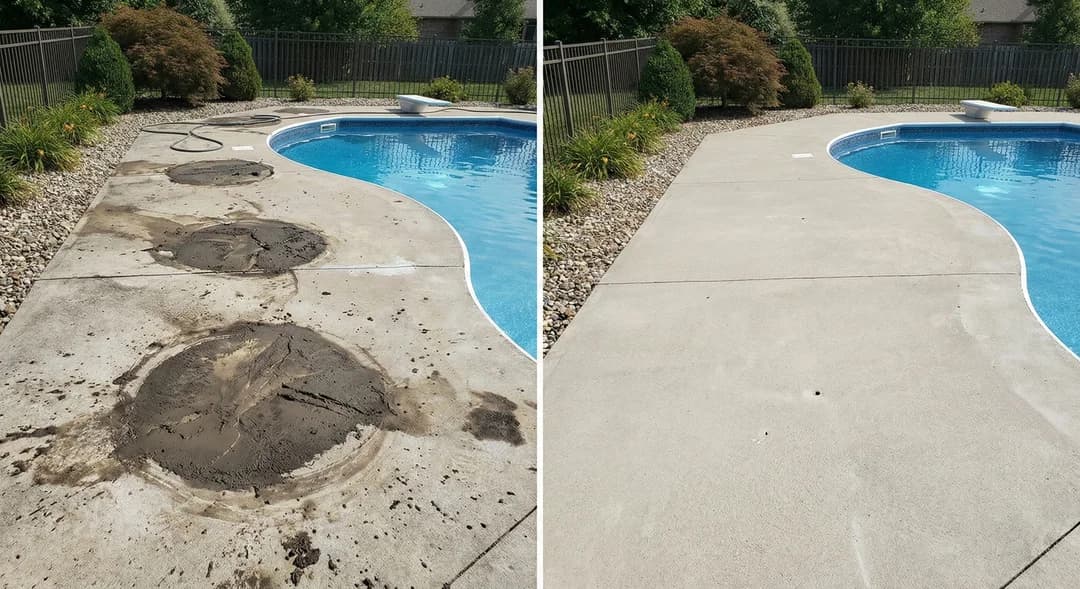
The Sinking Slab Problem: Understanding Your Concrete Leveling Solutions
For homeowners who have invested in premium outdoor living spaces, noticing a sinking pool deck or an uneven patio is more than a cosmetic annoyance—it is a significant safety hazard and a threat to property value. The root cause is often soil erosion or poor compaction, creating voids beneath the slab that can no longer support the concrete's weight. If left unaddressed, these voids lead to cracking, water pooling, and dangerous trip hazards. When evaluating repair options, you will primarily encounter two distinct methods: traditional mudjacking and modern high-density polyfoam injection.
Traditional Mudjacking (also known as slab jacking) relies on pumping a heavy, cement-based slurry beneath the concrete to hydraulically lift it. While this method has been used for decades, it involves drilling large injection holes and introducing significant weight to the soil. A major drawback is that this heavy mixture can overburden already compromised soil, potentially leading to future settlement (Anchor Foundation Repair, "How to Fix Erosion"). Furthermore, because the material is cementitious, it requires an extended curing time before the area can be used again.
High-Density Polyfoam Injection represents the evolution of concrete lifting. This process utilizes a two-part hydrophobic polyurethane polymer that expands rapidly upon injection to fill voids and lift the slab. Unlike mudjacking, polyfoam is exceptionally lightweight, exerting minimal pressure on the subgrade. Its hydrophobic properties allow it to repel water and resist washing away, making it a superior choice for areas with high moisture levels (Superior Grouting, "Using Polyurethane Foam"). Additionally, the foam cures within minutes, allowing for immediate use of the space (Groundworks, "How To Fill Concrete Slab Voids").
Choosing the right method is essentially about preserving the integrity of your hardscaping. While mudjacking offers a temporary fix, polyfoam injection provides a permanent, soil-stabilizing solution that protects your investment against future erosion cycles.
Aesthetics Head-to-Head: Will the Repair Ruin My Decorative Concrete?
For homeowners who have invested in stamped concrete, exposed aggregate, or custom pool decks, the thought of drilling holes into the surface is often the biggest barrier to repair. When comparing polyfoam injection vs mudjacking, the difference in visual impact is stark. While both methods require drilling, the invasiveness and final appearance of the repair differ significantly, directly affecting your property’s curb appeal and long-term value.
The Drill Hole Comparison: Penny vs. Soda Can
The most immediate aesthetic difference lies in the size of the injection ports. Traditional mudjacking relies on a thick slurry of sand, cement, and soil, which requires high pressure and large volume to lift a slab. To accommodate this material, contractors must drill large holes—often 1 to 2 inches in diameter—every few feet (Wisconsin Department of Transportation, "Evaluation of the URETEK Method"). Visually, this is comparable to the diameter of a soda can, leaving large scars across the surface of your patio or pool deck.
In contrast, hydrophobic polyurethane foam is a low-viscosity liquid that expands chemically once beneath the slab. This allows for significantly smaller injection ports, typically around 5/8 of an inch, which is smaller than a penny (Wisconsin Department of Transportation). Since the foam travels effortlessly to fill voids, fewer holes are needed to achieve the same result, drastically minimizing disruption to your decorative finish.
The "Polka-Dot" Effect vs. The Invisible Repair
The aftermath of a mudjacking repair often results in what industry professionals call the "polka-dot" effect. The large 2-inch holes must be patched with fresh concrete. Since it is nearly impossible to color-match new cement to weathered, sun-faded concrete, the result is a grid of mismatched, gray circular patches that stand out against the original surface. For a high-end pool deck, this can permanently mar the aesthetic flow of the outdoor space.
Polyfoam ports, however, are small enough to be placed within the grout lines of stamped concrete or hidden among the texture of exposed aggregate. Once patched with a color-matched material, these penny-sized holes become virtually undetectable to the untrained eye. This capability is critical for maintaining the seamless look of luxury outdoor living spaces.
Protecting Your Outdoor Investment
Your outdoor living area is more than just a slab of concrete; it is a key component of your home's market value. With the global market for outdoor living structures projected to grow significantly as homeowners prioritize relaxation and aesthetics (Grand View Research, "Outdoor Living Structure Market Size"), preserving the visual integrity of these spaces is a financial priority. Furthermore, exterior improvements consistently drive high returns on investment, with curb appeal acting as a primary value driver (Builder Magazine, "The 2024 Cost vs. Value Report"). Choosing a repair method that stabilizes soil erosion and corrects alignment without leaving unsightly scars ensures that your repair adds value rather than subtracting from it.
Equipment Access: Saving Your Landscaping from Heavy Machinery
When you invest in restoring your pool deck or patio, the repair process shouldn't create a new project for your landscaper. One of the most significant yet overlooked differences between concrete leveling methods is the logistical footprint required to perform the work. Traditional mudjacking often necessitates bringing heavy machinery directly onto your lawn, whereas high-density polyfoam injection is designed for non-invasive, remote access.
The Logistics of Mudjacking
Mudjacking relies on a thick, cement-based slurry that weighs approximately 100 pounds per cubic foot (Superior PolyLift, "Polyurethane vs Mudjacking"). Because this material is heavy and viscous, it cannot be pumped efficiently over long distances without losing pressure. Consequently, contractors must often drive heavy pump trucks or skid steers within 10 to 20 feet of the repair site. For a backyard pool deck, this typically means removing fence panels and driving equipment over your manicured lawn, creating a high risk of soil compaction and ruts.
The Polyfoam Advantage: Remote Access
In contrast, hydrophobic polyurethane foam is extremely lightweight, weighing only 2 to 4 pounds per cubic foot (Sealtite Insulation, "Mudjacking vs. Polyurethane"). This unique chemical property allows the material to be transported through long, slender hoses that can reach up to 300 feet from the rig. The result is a "park-at-the-curb" solution where the heavy truck remains on the street, and only a crew member hauling a lightweight hose enters your backyard.
Risk Assessment: Protecting Your Property
The difference in equipment weight directly correlates to the safety of your underground utilities. Driving heavy machinery over residential lawns is a leading cause of damage to irrigation systems, often resulting in crushed sprinkler heads or broken pipes (Spartan Irrigation, "Risks to Sprinklers"). By choosing polyfoam injection, you eliminate this risk entirely. The process offers specific benefits for hard-to-reach areas:
Tight Entry Points: Hoses can be easily routed through standard garden gates or around fenced perimeters without dismantling structures.
Preserved Vegetation: Crews can navigate around flower beds and fragile landscaping features that would otherwise be trampled by heavy machinery.
Zero Cleanup: Because the injection equipment is self-contained and leaves no slurry residue, your pool deck remains clean and ready for immediate use.
Durability and Environment: Hydrophobic Foam vs. Cement Slurry
When evaluating polyfoam injection vs mudjacking, the physical properties of the material injected beneath your concrete are the most critical factors for longevity. While traditional mudjacking relies on a cement-based slurry, modern concrete leveling solutions utilize high-density polyurethane foam. This difference in material composition directly impacts the stability of the soil and the long-term preservation of your pool deck or patio.
The Burden of Weight on Weak Soil
The primary cause of sunken concrete is often soil that is too weak or poorly compacted to support the slab above it. Adding more weight to this already compromised sub-base can accelerate settling. Traditional mudjacking slurry is heavy, typically adding significant mass to the soil. In contrast, high-density polyurethane foam is incredibly lightweight, with government specifications often requiring a density of only 3.8 to 4.2 pounds per cubic foot (Texas Department of Transportation, "Special Specification 3086"). This lightweight nature minimizes stress on the underlying soil, preventing the "anchor effect" where heavy repair materials cause further sinking.
Water Resistance and Hydrophobic Properties
For pool decks and outdoor patios, water resistance is non-negotiable. Cement slurries used in mudjacking are porous and can erode or wash out over time, especially in areas with poor drainage or high water tables. Conversely, hydrophobic polyurethane foam is designed to repel water. It remains dimensionally stable and cures even in wet conditions, ensuring that the repair holds up against rain, splash-out, and soil moisture (Superior Grouting, "Environmental Benefits"). This makes polyfoam the superior choice for pool deck repair, where moisture exposure is constant.
Deep Void Filling and Soil Stabilization
Beyond lifting, the goal of any repair should be soil erosion stabilization. Polyfoam is injected as a liquid that expands aggressively to fill voids deep within the sub-base. This expansion locks loose soil particles together, stabilizing the ground before lifting the slab. Unlike mudjacking, which forms a heavy "patty" under the slab, polyfoam integrates with the soil to create a composite base that resists future movement (Jongpradist, et al., "Performance Comparison").
Environmental Safety
Homeowners are often concerned about introducing chemicals into their yard, particularly near swimming pools. Once cured, high-density polyurethane is an inert material that does not leach chemicals into the surrounding soil or groundwater. It is environmentally safe, non-toxic, and provides a permanent, water-resistant solution without the risk of contaminating your landscape.
The Cost Equation: Is Polyfoam Worth the Investment?
When evaluating polyfoam injection vs mudjacking, the initial price tag often dictates the conversation. It is true that traditional mudjacking is the cheaper option upfront, typically costing between $3 and $6 per square foot compared to the $5 to $25 per square foot average for polyurethane injection (Mudjacking Contractor, "Mudjacking vs. Polyjacking Cost"). However, for homeowners focused on long-term property preservation rather than a temporary patch, the "lowest bid" can be deceptive. The real cost equation must include maintenance frequency, material longevity, and the protection of your home's resale value.
The divergence in value stems from the material itself. Mudjacking relies on a heavy slurry of sand, cement, and water. While this mixture fills voids, it is not hydrophobic. This means it is susceptible to the same water intrusion and soil erosion stabilization issues that caused the concrete to settle in the first place. Industry data suggests that mudjacking repairs may require re-pumping within two to five years due to material erosion (A-1 Concrete Leveling, "5 Common Mudjacking Myths Busted"). In contrast, high-density polyfoam cures within 15 minutes and becomes chemically inert and waterproof. It permanently compacts the sub-grade soil without adding significant weight, effectively eliminating the risk of future washout.
Finally, consider the return on investment (ROI) regarding your property’s aesthetics. A leveled, safe pool deck or patio is not just a cosmetic luxury; it is a critical asset. Real estate reports indicate that repairing and refinishing existing outdoor living spaces can yield an ROI of nearly 500% at resale (Extra Space Storage, "6 Outdoor Living Space Features"). By choosing a permanent concrete lifting solution like polyfoam, you are not merely fixing a trip hazard—you are locking in the equity of your outdoor living space for decades.
Conclusion: Why Black Birch Contracting Recommends the Non-Invasive Choice
For discerning homeowners, the decision between these two methods ultimately comes down to preserving the integrity of the landscape. While traditional mudjacking has served its purpose in the past, it functions as a "sledgehammer" approach—forcing heavy, cementitious slurry into voids. This material adds significant weight to already compromised soil, potentially exacerbating the settlement issues it was meant to solve. In contrast, high-density polyfoam acts as a surgical intervention. It is lightweight, reducing the overburden on weak substrates, and cures within minutes rather than days.
The superior engineering behind polyfoam is particularly critical for pool decks and patios exposed to moisture. Unlike cement slurries that can wash away or degrade, hydrophobic polyurethane chemically stabilizes the underlying soil. Research indicates that hydrophobic foam effectively mitigates soil swelling and shrinkage even in reactive environments, providing a permanent barrier against erosion (Al-Swaidani et al., "Novel Application of HPUF"). Furthermore, civil engineering studies have demonstrated that foam injection offers faster setting times and comparable, if not superior, load-bearing improvements compared to traditional grouts (Vennapusa and White, "Comparison of Pavement Slab Stabilization").
The Final Verdict: We choose polyfoam because it respects your property’s aesthetics. The injection ports are roughly the size of a dime—drastically smaller than the soda-can-sized holes required for mudjacking—leaving your custom concrete finishes virtually untouched.
Don't let settling concrete compromise the safety or beauty of your outdoor living space. Contact Black Birch Contracting today to schedule a consultation and discover how our non-invasive solutions can restore your property’s foundation.