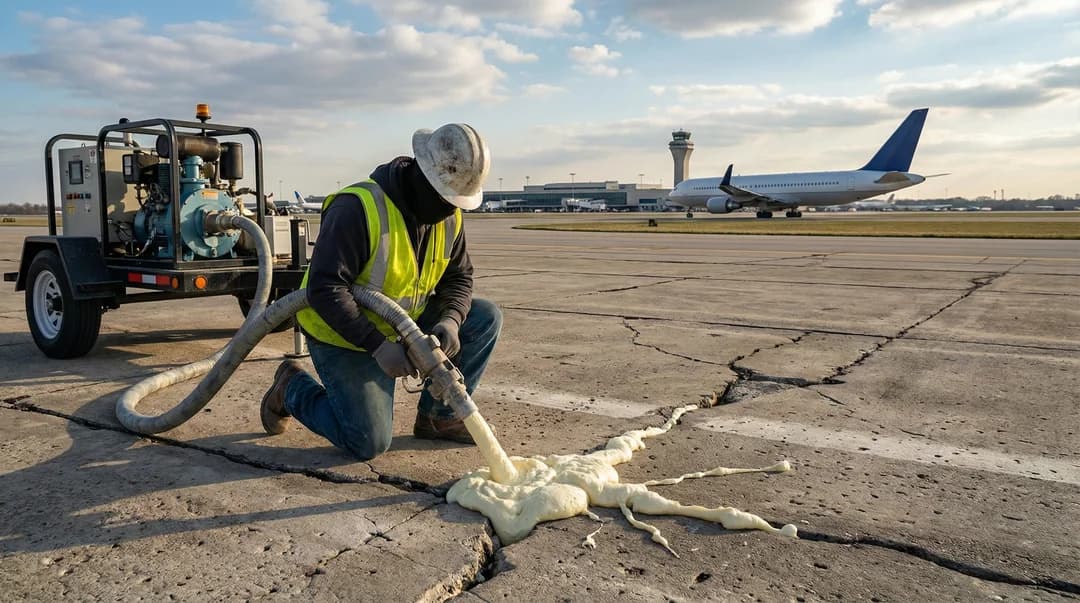
The Intersection of Speed, Strength, and Aviation Compliance
For airfield maintenance directors and civil engineers, the margin for error on a runway is non-existent. At Black Birch Contracting, we recognize that we are not merely repairing pavement; we are securing the operational continuity of regional and international aviation hubs. The challenge has always been balancing the urgent need for runway slab lifting and leveling with the prohibitive costs of flight delays. Traditional "rip-and-replace" methods often require days of curing time—a logistical nightmare for flight schedules. Modern aviation infrastructure demands a solution that aligns speed with the rigorous performance standards of the FAA and Transport Canada.
High-density polyfoam grout has emerged as the premier solution for airfield pavement restoration, offering a cure time that allows runways to reopen in hours rather than days. Recent industry data indicates that polyurethane concrete raising is over 80% quicker than alternative repair methods, significantly reducing downtime costs (Powerlift Foundation Repair, "High Density Polyurethane"). Beyond speed, this method creates a dimensionally stable, hydrophobic subgrade capable of supporting massive dynamic loads. By addressing the root cause of settlement—weak soil bearing capacity—we restore the Pavement Classification Number (PCN) without the carbon footprint of heavy excavation.
However, speed and strength must ultimately serve compliance. Our approach is "compliance-first," ensuring that every injection meets the strict tolerances required for safety audits. Unstable slabs are a primary generator of foreign object debris (FOD), as rocking panels grind continuously to produce loose aggregate. Stabilizing these slabs is critical for FOD prevention strategies outlined in FAA pavement compliance guidelines like Advisory Circular 150/5380-6C. Furthermore, our precise leveling techniques correct runway deflection to within 1/100th of an inch, meeting the smooth profiles mandated by Transport Canada airfield standards. With Black Birch Contracting, you gain a partner technically capable of delivering airport runway polyurethane stabilization that satisfies both the engineer’s structural requirements and the auditor’s safety checklist.
Restoring Load-Bearing Capacity (PCN) for Heavy Aircraft
In the aviation sector, the structural integrity of a runway is defined by its ability to withstand the immense static and dynamic loads of heavy aircraft. When subgrade soils settle or erode, the effective Pavement Classification Number (PCN) of the slab drops, creating a dangerous disparity between the pavement’s strength and the Aircraft Classification Number (ACN). We utilize airport runway polyurethane stabilization to reverse this degradation. Unlike surface patching, high-density polyfoam grout is injected directly into the subgrade, where it undergoes an exothermic reaction and expands up to 30 times its liquid volume (Liu et al., "Grouting Mechanism of Polyurethane"). This expansion permeates weak soil strata, filling voids and compressing loose material to restore the composite strength required for Code F aircraft operations.
The primary mechanism for restoring load-bearing capacity is the aggressive densification of the subgrade. As the polyfoam expands, it exerts lateral and vertical pressures ranging from 50 to 100 PSI, effectively compacting the surrounding soil matrix. Recent industry data indicates that this deep-injection process can increase soil bearing capacity by 50% to 200%, ensuring the pavement structure meets or exceeds its original design PCN (Superior PolyLift, "Polyurethane Foam vs. Soil Issues"). This method aligns with Transport Canada AC 302-011 standards for reporting pavement strength, allowing operators to validate PCN improvements through non-destructive Falling Weight Deflectometer (FWD) testing immediately after application.
Compared to traditional cementitious grouting, high-density polyfoam grout offers superior performance for aviation applications. Cement grout weighs approximately 100-120 lbs/cu ft, which can overburden already compromised soils and lead to further settlement. In contrast, structural polyurethane weighs only 4-6 lbs/cu ft while providing equivalent or greater support (Onyang, "Comparison of Pavement Slab Stabilization"). Furthermore, polyfoam is hydrophobic and hydro-insensitive, meaning it displaces water and cures fully even in saturated subbases, eliminating the "washout" risk associated with mudjacking. This rapid curing process allows runways to reopen to full traffic in just a few hours, significantly reducing downtime compared to the days required for cement to cure.
By stabilizing the subgrade, we eliminate the voiding that leads to catastrophic slab cracking and foreign object debris (FOD) generation. This proactive approach ensures compliance with FAA Advisory Circular 150/5380-6C guidelines for pavement maintenance, providing a long-term solution that corrects deflection and prevents future slab failure.
Navigating FAA and Transport Canada Airfield Standards
Aviation infrastructure is facing unprecedented demand, with global passenger numbers projected to reach 4.7 billion in 2024 (S&ME, "Market Insights"). As flight frequencies increase, the window for runway maintenance shrinks, forcing airfield directors to seek repair methods that are both rapid and rigorously compliant. Polyurethane stabilization has emerged as a preferred solution not just for its speed, but for its alignment with the strict regulatory frameworks established by the Federal Aviation Administration (FAA) and Transport Canada.
For operations under FAA jurisdiction, compliance begins with Advisory Circular 150/5380-6C. This guideline explicitly identifies "expandable foam injection" as a recognized method for slab leveling and base stabilization (FAA, "AC 150/5380-6C"). Unlike "rip-and-replace" strategies that can ground operations for weeks, high-density polymer injection restores the Pavement Condition Index (PCI) by re-establishing load transfer between slabs. This process directly addresses the deflection issues that lead to spalling and corner breaks, ensuring the pavement meets the structural requirements for its designated Pavement Classification Number (PCN).
In Canada, the focus often shifts to surface regularity and friction coefficients. Transport Canada’s TP 312 (5th Edition) mandates that runway pavements must remain free of irregularities that could "result in reduced friction characteristics or adversely affect aircraft operations" (Transport Canada, "TP 312"). Settled slabs create dangerous bumps (roughness) and water pooling hazards that compromise braking efficiency. Precision foam injection corrects these deviations within millimeters, instantly restoring the grade to meet the smoothness standards required for certification.
Documentation and Audit Readiness
Technical performance is only half the battle; validation is the other. Modern aviation contracting requires a "digital thread" of accountability to satisfy regulatory audits. Compliant stabilization projects must include:
Material Traceability: Verification that the injected material meets ASTM D1621 standards for compressive strength, ensuring it can support heavy aircraft loads without deformation.
Mapped Injection Points: Utilizing GPS or laser-referenced data to record the exact location and volume of material placed at every injection port.
Post-Repair Validation: Immediate elevation surveys to confirm the removal of deflection and restoration of the runway profile.
By leveraging these compliant rehabilitation methods, airport operators can extend the service life of their runways while satisfying the rigorous safety mandates of North American aviation authorities.
Data-Driven Verification: NDT and Deflection Correction
Visual confirmation of a level slab is insufficient evidence of structural integrity for civil engineers and maintenance directors. A runway may appear flush, but if the subgrade voids remain, the pavement will inevitably fail under the cyclic loading of heavy aircraft. To ensure airport runway polyurethane stabilization meets strict aviation standards, we move beyond visual checks and rely on quantitative data derived from Non-Destructive Testing (NDT).
The diagnosis begins with Falling Weight Deflectometer (FWD) testing. By applying a dynamic load that simulates actual aircraft impact, we measure the vertical deflection of the pavement surface. High deflection values indicate a loss of support or voiding in the sub-base. This data is critical for compliance, as the Federal Aviation Administration defines specific metrics for Load Transfer Efficiency (LTE), requiring that joints transfer sufficient load to adjacent slabs to prevent corner breaks and faulting (FAA, "AC 150/5320-6G").
Once the baseline is established, we utilize high-density polyfoam grout for runway slab lifting and leveling. Unlike traditional mudjacking, this method allows for precision monitoring. We track lift in real-time using laser levels and dial indicators accurate to within millimeters, ensuring we correct deflection without inducing stress cracks that could lead to foreign object debris (FOD) prevention issues later. Recent engineering studies verify that polyurethane injection significantly increases the deformation modulus of the soil-polymer composite, effectively restoring the bearing capacity of the treated area (Sabri et al., "Soil Injection Technology").
The final phase is post-repair verification. We re-deploy FWD testing to generate a "before and after" comparison. This report provides the engineering team with concrete proof that the Pavement Classification Number (PCN) requirements are met and that the LTE across joints has been restored to acceptable levels. This documentation is essential for satisfying Transport Canada airfield standards and provides a liability shield by proving that the pavement has been stabilized to handle designated aircraft loads.
Operational Advantages: Efficiency, Durability, and Safety
For airfield operators, pavement availability is directly linked to operational capacity and revenue. Traditional concrete replacement methods for repairing settled runways often require days of curing time, forcing extended closures and costly diversions. In contrast, airport runway polyurethane stabilization offers a rapid return to service. High-density polyfoam grout cures to 90% strength within 15 to 30 minutes, allowing runways to reopen within hours once surface patching, inspections, and operational clearances are complete (Level Up, "What Is Polyurethane Slab Lifting?"). This efficiency minimizes disruption to flight schedules while delivering a repair that addresses the root cause of settlement—weak subgrade soils.
Beyond speed, the structural integrity of the repair is critical for meeting aviation standards. Modern high-density foams are engineered to support heavy aircraft loads, effectively restoring the Pavement Classification Number (PCN) without adding significant overburden to the soil. This method aligns with strict performance requirements for surface roughness and friction, such as those outlined in Transport Canada’s pavement management guidelines (Transport Canada, "Advisory Circular AC 302-016"). By stabilizing the subbase, we prevent future deflection, ensuring the long-term durability required for international and regional airfields.
Safety compliance, particularly regarding Foreign Object Debris (FOD), is another primary advantage of foam stabilization. Uneven pavement transitions and spalling concrete are significant generators of FOD, which costs the global aviation industry an estimated $4 billion annually in damages and delays (FOD Control, "Runway Maintenance 101"). By precisely lifting and leveling slabs to eliminate "lippage," polyfoam injection removes these hazards, protecting aircraft landing gear and engines. This proactive maintenance approach ensures compliance with FAA and Transport Canada safety protocols while significantly reducing long-term rehabilitation costs.
Conclusion: Partnering for Long-Term Runway Health
Deciding to adopt airport runway polyurethane stabilization goes beyond simple pavement repair; it represents a strategic investment in operational continuity and safety. Unlike traditional remove-and-replace methods that can shut down critical infrastructure for weeks, high-density polyfoam grout offers a rapid, minimally invasive alternative that restores load-bearing capacity in hours, not days. By addressing the root cause of settlement through deep soil stabilization for aviation, facility managers can permanently arrest runway deflection correction issues before they escalate into structural failures.
From a regulatory perspective, this method directly supports compliance with rigorous performance mandates. Properly executed runway slab lifting and leveling restores the surface profile to meet FAA pavement compliance guidelines under Advisory Circular 150/5380-6C (Federal Aviation Administration, "Guidelines and Procedures..."). Furthermore, by eliminating the lip hazards and spalling associated with uneven slabs, airports significantly improve foreign object debris FOD prevention protocols. Recent studies indicate that delaying preventative maintenance on airfield pavements can increase deterministic restoration costs by approximately 16% per year of delay (Babashamsi et al., "Life-cycle cost analysis..."), making immediate stabilization a financial imperative. This proactive approach also ensures the preservation of the runway’s Pavement Classification Number PCN, a critical metric for Transport Canada airfield standards and international operations (Transport Canada, "Airport Pavement Strength...").
At Black Birch Contracting, we understand that airfield pavement restoration requires more than just materials; it demands precise engineering and a commitment to safety. Our team is equipped to deliver documentation and testing data that aligns with civil aviation requirements, ensuring your rehabilitation project stands up to scrutiny. Do not wait for minor settlement to impact flight operations. Contact Black Birch Contracting today to schedule a comprehensive structural evaluation and secure the longevity of your airfield assets.