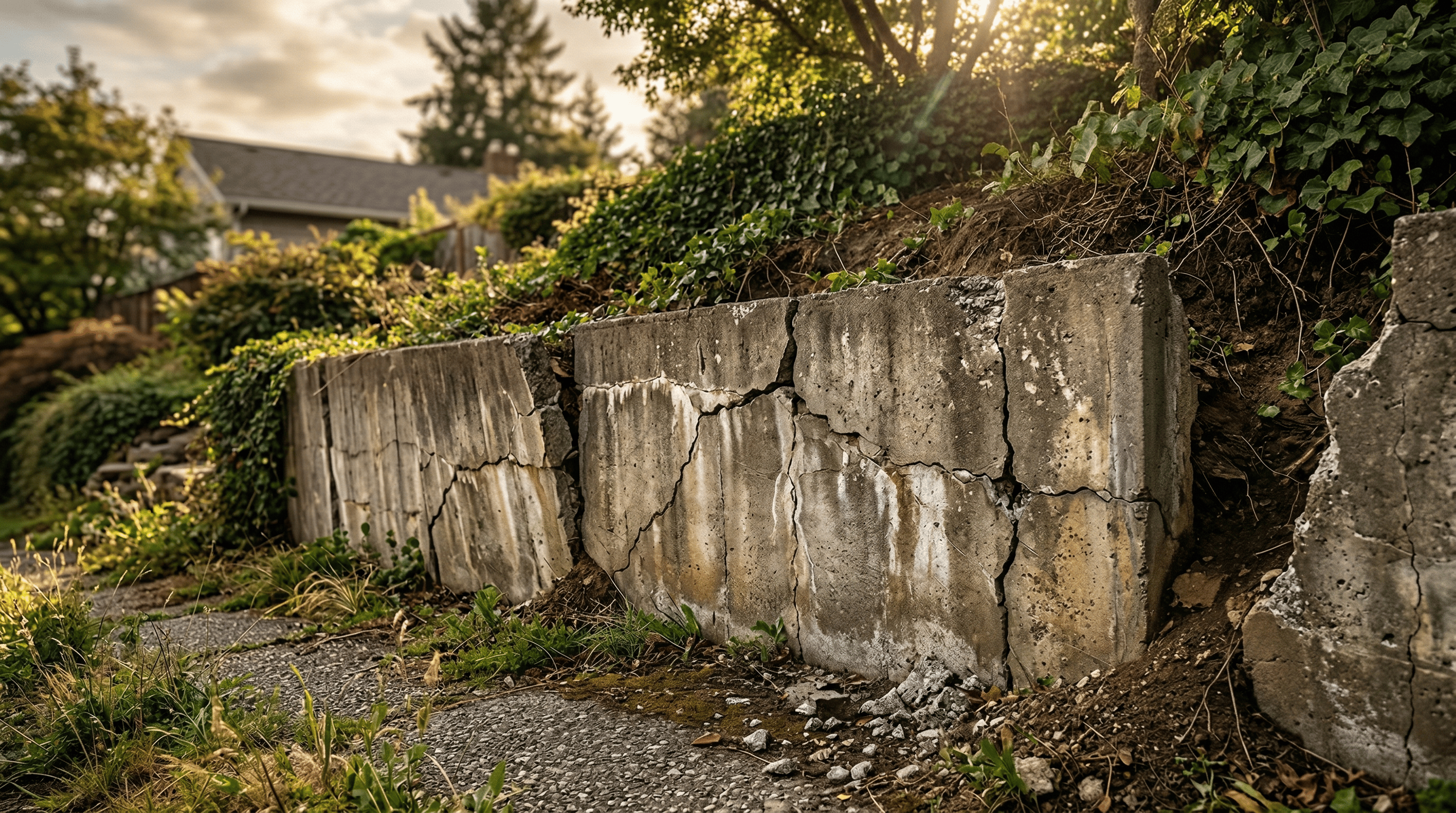
A retaining wall spends its whole life pushing back, and when the balance slips it gives warning long before it fails, though the early signals are easy to write off as age or weather. Walls in the Fraser Valley have a harder job than most: long wet stretches saturate the backfill, clay-rich soils swell and shrink through the seasons, and a slope that looks settled in August can behave differently in January.
Forces Acting on a Retaining Wall
Soil pushes outward with a force that grows with depth, which is why the bottom third of a wall carries the heaviest load and why failures so often start there. Water changes the math quickly: saturated soil is heavier than dry soil, and when backfill cannot drain, water pressure builds against the back of the wall on top of the soil pressure it was designed for. Drainage behind the wall, more than the wall's own mass, is what decides whether it stays put.
Leaning, Bulging, and Displacement
Lean is the sign homeowners notice first and dismiss most often. Stand at one end, close one eye, and sight down the face. Many walls are built tilting slightly back into the slope on purpose, so the test is not whether the wall is plumb but whether it still leans back rather than out.
Bulging is more urgent. A belly in the face means pressure is concentrated in one area, usually where water collects or where backfill was never properly compacted. Displacement is the third pattern: sections sliding out at the base, blocks separating at the top, or a gap opening where the wall meets stairs or grade. Movement that continues from one wet season to the next has gone past the point of watching.
Crack Direction and Width
Fine surface cracking from shrinkage or weathering is common in older concrete and is usually a maintenance item. Cracks that matter have direction and displacement. Horizontal cracking partway up a wall points to lateral pressure bending the structure. Diagonal or stair-step cracking through mortar joints points to differential settlement of the footing. A vertical crack noticeably wider at one end suggests one section is rotating away from another. Sorting a serious crack from a harmless one works the same way as on a foundation, which we cover in reading a crack by width, direction, and location.
Drainage Failures Behind the Wall
Behind a properly built wall sits free-draining gravel backfill, a perforated pipe at the base, filter fabric keeping fine soil out of the gravel, and weep holes or a daylighted outlet. Remove any one of those and the wall starts collecting water instead of shedding it.
The failure is rarely dramatic. Fabric clogs, fine particles migrate into the gravel, the pipe silts up, or the outlet gets buried during landscaping, and the system quietly stops working years after the wall was built. The evidence shows up from the front: water seeping through the face, standing water at the base after rain, or weep holes discharging muddy water. Redirecting water is almost always cheaper than building something strong enough to resist it.
Surcharge and Erosion
Surcharge is any weight added above a wall beyond the soil itself: a driveway, a vehicle near the edge, a patio, or fill brought in to level the upper yard. A wall built to hold a lawn is not a wall built to hold a truck, so if movement started after work at the top of the slope, the added load is the first thing to check.
Water travelling through backfill rather than draining out of it carries soil with it, leaving voids behind and beneath the wall. Depressions along the top, soil at the base, or a widening gap between the wall and adjacent grade all point to it, and support disappears without anything looking wrong from the front. It is the same process that hollows out the ground beneath a concrete slab.
Surface Damage vs Movement
One test sorts most cases: does the sign involve movement, or only surface condition? Chipping, staining, efflorescence, and stable hairline cracks are surface condition, though efflorescence and spalling do confirm water is moving through the wall rather than around it. Lean, bulge, displacement, joint separation, and cracks that widen between seasons are movement, and movement cannot wait, because whatever is causing it is still working.
When an Engineer Is Required
Some walls are landscaping and some are structure. Once a wall is well over a metre tall, carries a surcharge, is tiered above or below another wall, or retains soil supporting a building, driveway, or neighbouring property, the design belongs to a geotechnical or structural engineer. Many Fraser Valley municipalities also require a permit and engineered drawings above a set height, commonly around 1.2 metres, so local requirements are worth confirming before a rebuild is priced. An engineer is also the right call when a wall is moving with intact drainage, because the problem may sit in the soil, the footing, or the slope itself.
Repair Sequence and Maintenance
Patching the face of a moving wall buys very little. A repair that lasts starts with the cause, which usually means excavating behind the wall to expose the drainage, replacing clogged gravel and fabric, installing or replacing the drain pipe, and giving it a proper outlet. Grading above the wall gets corrected too. Only then does the structure get addressed, whether that means rebuilding failed sections, adding tiebacks or soil anchors, underpinning a settled footing, or filling voids to restore support. On our projects the sequence is fixed: water first, then support, then structure, then finishes, which is why the order of repairs matters as much as the repairs themselves.
Clearing weep holes, redirecting a downspout, and keeping heavy loads off the ground above a wall are sensible maintenance, as is photographing the wall from the same positions each season. Rebuilding a leaning wall is a different matter, because excavating at the base of a wall already under load is dangerous.
Frequently Asked Questions
What are the most common signs that a retaining wall needs repair in the Fraser Valley?
Visible leaning or bulging, cracks running through mortar joints or the wall face, soil pushing through gaps, and water pooling at the base are the usual warning signs. These develop faster here than in drier climates because heavy seasonal rainfall, clay-heavy soils, and freeze-thaw cycles all load the wall at once. Catching them early keeps repair costs manageable.
What causes retaining walls to fail in Chilliwack and the broader Fraser Valley?
Saturated soil increases lateral pressure well beyond what many walls were designed for, and blocked drainage lets water pressure build behind the structure. Clay soils that swell and shrink with moisture, root intrusion from nearby trees, freeze-thaw damage, and loads added above the wall after it was built are the other common contributors.
Is a leaning or cracking retaining wall a safety hazard?
A wall that is visibly leaning, bulging, or cracking with displacement should be treated as a safety concern. Retaining walls hold back a considerable weight of soil, and failure can destabilize a slope, damage a driveway or foundation, and put anything below the wall at risk. Walls near a house, parking area, or walkway warrant faster attention.
Can a damaged retaining wall be repaired, or does it need to be fully replaced?
Repair is often possible when the problem is caught early. The right approach depends on the wall type, how far it has moved, and what caused the failure. Drainage faults can usually be corrected as part of a targeted repair, while severe displacement or rot at the base of a timber wall tends to point toward replacement as the better long-term value.
When should a professional look at a retaining wall?
Call when a wall is leaning or bulging, when cracks widen between seasons, when soil is visibly washing out, or when water is showing up near the foundation. Minor surface cracks can be monitored, but any sign of movement in a load-bearing wall warrants an evaluation. Acting early almost always means a less invasive and less expensive repair.
Retaining walls do quiet but essential work on a property every day, and the Fraser Valley climate makes routine attention to their condition worthwhile. If you have noticed any of the warning signs covered here, Black Birch Contracting is ready to help you assess the situation and find the right repair approach for your wall and your budget. Reach out anytime to get started.