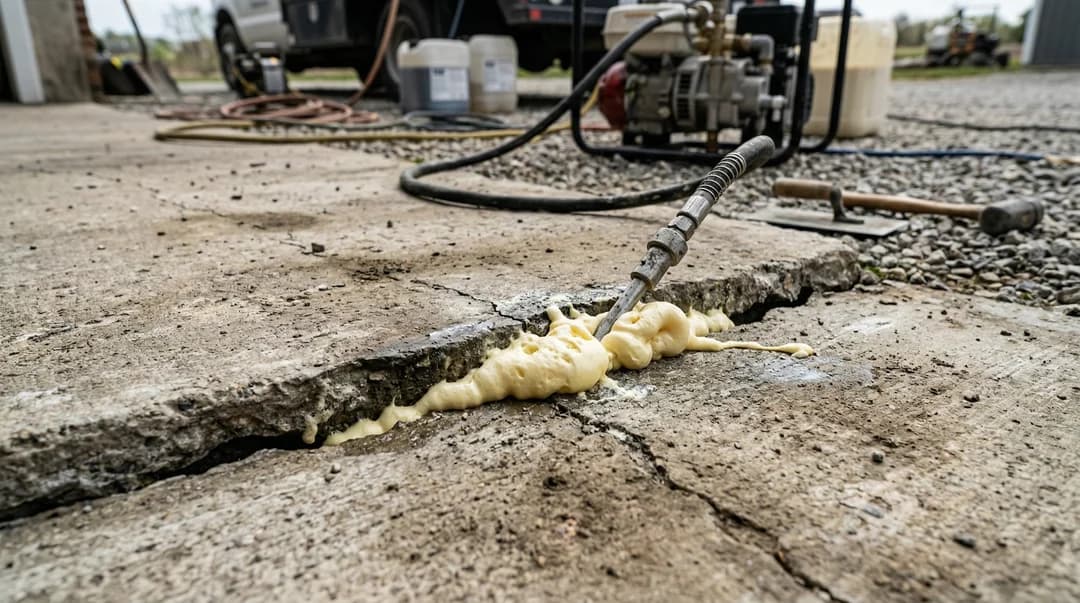
Introduction: From Liquid to Rock-Hard Seal
To the untrained eye, the application of polyfoam grout can look like magic: a thin liquid is injected into the ground, and moments later, it rapidly expands to lift massive concrete slabs or seal gushing leaks. However, this process is not magic—it is a precise application of chemical grouting science. Polyfoam grout, specifically polyurethane injection, is a two-component polymer system designed to address modern infrastructure challenges where traditional mudjacking or cement repairs fail. As a solution for infrastructure waterproofing and soil stabilization, polyurethane foam has become a critical tool for engineers, offering superior impermeability and durability compared to older methods (Sunanda Global, "Polyurethane Waterproofing").
The core of this technology lies in an exothermic reaction. When the two primary components—an isocyanate and a polyol resin—are mixed at the injection nozzle, they generate heat and carbon dioxide almost instantly. This reaction causes the material to expand to 15–30 times its original liquid volume, driving the foam into microscopic fissures and voids (Wang et al., "Research Progress on Polyurethane-Based Grouting"). Unlike passive fillers, this expanding foam sealant actively exerts pressure, compacting loose soil and displacing trapped water. For property owners, understanding this reaction is vital: it explains why the repair is not just a surface patch but a structural reintegration of the soil and foundation.
Water plays a unique role in this process. Depending on the formulation, hydrophilic vs. hydrophobic grout behaves differently; some blends seek out moisture to catalyze the expansion, while others are engineered to repel water entirely, creating a permanent barrier against saturation. Recent engineering reviews highlight that polyurethane’s self-expansion force allows it to penetrate fractures inaccessible to cement, effectively sealing high-pressure water inflows (Zhang et al., "Analytical Solution for Expandable Polyurethane"). At Black Birch Contracting, we leverage this chemistry to ensure that every injection provides a rock-hard, long-lasting seal that restores stability to your property.
The Composition: What Is Polyfoam Grout?
Polyfoam grout, technically known as polyurethane injection resin, is a high-performance geotechnical polymer used to stabilize soil, lift concrete, and seal structural leaks. Unlike traditional repair methods that rely on heavy aggregates, modern polyfoam is a two-component system created by mixing an isocyanate (Component A) with a polyol resin blend (Component B). When these two liquids combine at the injection nozzle, they trigger a rapid exothermic reaction, transforming the mixture from a low-viscosity liquid into a rigid, expanded foam (Fauzi et al., "Physical and Morphological Analysis").
The efficacy of this solution lies in its ability to penetrate where traditional materials cannot. Before the reaction creates foam, the material enters the soil or concrete void as a fluid with a viscosity similar to water. This allows the resin to travel deep into microscopic hairline fractures and loose soil pores before expanding up to 25 times its liquid volume (Dongsen Chemicals, "Polyurethane Formulation"). As the foam expands, it displaces water and bonds chemically with the substrate, creating a permanent, hydrophobic seal that prevents future saturation.
It is critical to differentiate this chemical process from "mudjacking," which pumps a heavy cementitious slurry into voids. Cement grout relies on bulk filling and can weigh over 100 lbs per cubic foot, potentially adding stress to already weak soil. In contrast, polyurethane grout creates a structural lift through expansive pressure while weighing as little as 2-4 lbs per cubic foot, significantly reducing the load on the foundation (Superior Grouting, "Why Does Polyurethane Beat Cement"). This makes polyfoam the preferred solution for infrastructure waterproofing and load-bearing soil stabilization.
The Reaction: How the Exothermic Process Drives Expansion
The structural transformation of polyfoam grout begins the moment the two primary components—polyol resin and isocyanate—collide at the tip of the injection gun. This immediate blend, often referred to as "impingement mixing," triggers a rapid chemical sequence that converts liquid material into a high-density solid capable of stabilizing soil and lifting concrete slabs.
The catalyst for this expansion is an exothermic reaction. As the components mix, they generate significant heat, which drives the process forward and accelerates the material's state change. According to recent industry analysis, this release of heat is crucial not only for curing the resin but for facilitating the "blow reaction" that creates the foam's volume (Deming Machinery, "How does Copolymer Polyol react..."). The heat ensures that the material cures effectively even in cool soil temperatures, allowing for year-round application.
Simultaneously, the reaction produces the cellular structure that defines polyfoam grout. When the isocyanate reacts with water (either moisture present in the soil or a catalyst in the mixture), it decomposes to form urea and releases Carbon Dioxide (CO2) gas. This gas acts as a blowing agent, creating millions of microscopic bubbles that get trapped within the thickening resin (Sabtech, "An Introduction to the Principles...").
This process happens in seconds. The expanding gas forces the material into voids and weak soil zones, while the polymer resin hardens around the gas bubbles. The result is a rigid, closed-cell lattice that permanently locks the soil in place. Recent chemical engineering reviews highlight that this network of urethane linkages provides the foam with its high compressive strength and chemical stability (Singh and Repo, "Carbon dioxide utilization..."). Unlike mudjacking slurries that rely on bulk water evaporation to dry, polyfoam cures chemically, ensuring the final volume remains consistent without shrinkage.
Hydrophilic vs. Hydrophobic: Utilizing Water in the Equation
While the expanding action of polyfoam grout may look similar on the surface, the chemistry occurring underground differs significantly depending on the type of resin used. The success of a foundation repair or soil stabilization project often hinges on selecting the correct chemical profile: hydrophilic or hydrophobic. These terms describe how the polymer reacts when it encounters moisture, which is almost always present in compromised foundations.
Hydrophilic Grout: The "Water-Loving" Flexible Seal
Hydrophilic grouts have a high affinity for water. Instead of repelling moisture, these resins seek it out and absorb it into their chemical structure during the curing process. As the grout reacts, it creates a chemical and mechanical bond with the water, resulting in a flexible, foam-like gel (Alchatek, "Hydrophobic vs Hydrophilic"). Because they incorporate water rather than displacing it, hydrophilic grouts are ideal for stopping active leaks in tight cracks or joints where ongoing thermal movement requires a material that can stretch and compress without breaking its seal. However, because water is a component of the final structure, these grouts can be susceptible to shrinkage if the surrounding soil dries out completely, making them less suitable for environments with drastic moisture fluctuations.
Hydrophobic Grout: The "Water-Fearing" Rigid Support
In contrast, hydrophobic grouts are designed to repel water. While they may use a small amount of moisture (or an added catalyst) to initiate the expansion reaction, they aggressively displace any excess water from the repair area. The result is a high-density, rigid foam that is dimensionally stable and impervious to water once cured (Adcos Asia, "Comprehensive Guide"). This makes hydrophobic polyfoam the superior choice for structural applications, such as lifting sinking concrete slabs or filling large voids in loose soil. Since the cured foam does not rely on trapped water to maintain its volume, it remains durable even during long dry spells or freeze-thaw cycles.
Choosing the Right Solution for Your Soil
Property owners must evaluate the specific conditions of their site before application:
Wet/Dry Cycles: For areas with variable water tables, hydrophobic grout is generally preferred because it will not shrink or degrade when the soil dries (Alchatek, "Hydrophobic vs Hydrophilic").
Active Water Flow: To stop a gushing leak immediately, hydrophobic grouts with a fast reaction time are often used to cut off the flow, sometimes followed by a hydrophilic injection to seal remaining micro-fissures.
Soil Stabilization: When the goal is to bind loose soil particles and increase load-bearing capacity, the rigid expansion of hydrophobic grout provides the necessary compressive strength that flexible gels cannot offer.
Mechanics of the Seal: Displacing Water and Filling Voids
The effectiveness of polyfoam grout lies in its ability to navigate microscopic pathways that traditional repair materials cannot reach. When the low-viscosity resin is injected into a compromised foundation or soil bed, it flows as a liquid, naturally seeking the path of least resistance. This allows the material to penetrate deep into hairline fractures, honeycombed concrete, and loose soil strata before the chemical reaction begins. Unlike surface patches that merely cover a defect, this injection process treats the root cause by occupying the same space that water previously used to enter the structure.
Once the resin encounters moisture or is exposed to air within the void, an exothermic reaction triggers rapid expansion. The material transforms from a thin liquid into a dense foam, expanding up to 20 to 30 times its original liquid volume (Faith Infraprojects, "PU Injection Grouting"). This massive expansion generates significant internal pressure, which is critical for two reasons: it compacts loose soil to stabilize the surrounding area, and it actively forces the resin into the tightest microscopic pores of the concrete, ensuring a comprehensive seal.
The crucial mechanism for waterproofing is water displacement rather than absorption. High-quality polyfoam grouts are typically hydrophobic, meaning they repel water. As the foam expands, it does not mix with the standing water in a crack; instead, it physically pushes the water out of the void. This hydrophobic chemistry ensures the foam creates a permanent, water-resistant structural support even in saturated environments (Superior PolyLift, "Polyurethane Void Filling"). The end result is a cured, closed-cell polymer gasket that bonds tenaciously to the concrete surface, forming an impermeable barrier that prevents future leaks and soil erosion.
Versatility: Sealing Leaks vs. Lifting Concrete
A common misconception among property owners is that "polyfoam" is a single, generic product. In reality, polyurethane grout is a versatile category of polymers where the chemical formulation dictates the function. Professionals engineer these resins to react differently based on whether the goal is to stop water intrusion or to structurally support a sinking foundation.
Sealing: High-Expansion, Low-Density Foams
When the objective is waterproofing—such as stopping active leaks in basement walls or tunnels—contractors utilize low-density foams with massive expansion rates (often expanding 20 to 25 times their liquid volume). These formulations are frequently categorized as hydrophilic (reacting with water to form a flexible gel) or hydrophobic (repelling water to form a rigid barrier). Hydrophobic grouts are particularly effective for permanent sealing because they do not shrink when the surrounding soil dries out, maintaining a watertight seal even during drought cycles (SealBoss Corp., "Hydrophobic versus Hydrophilic Polyurethanes").
Lifting: High-Density, Structural Foams
For foundation repair and soil stabilization, high-expansion foams are too soft to support structural weight. Instead, technicians inject high-density structural foam (typically 4.0 to 8.0 lbs per cubic foot). Unlike sealing grouts, these polymers are engineered for aggressive expansion force and high compressive strength. As the foam expands, it compacts the weak soil, fills voids, and exerts upward pressure to lift concrete slabs back to level.
Comparative Load-Bearing Capacity
The difference in strength is significant. While sealing foams are designed to withstand hydrostatic pressure, structural lifting foams must support the weight of the building and dynamic loads (like vehicles or machinery). Modern high-density polyurethane formulations can achieve compressive strengths exceeding 100 PSI, capable of supporting loads up to 14,000 pounds per square foot (Superior PolyLift, "Polyurethane Foam Load-Bearing Strength"). This makes them robust enough for heavy industrial flooring, highway infrastructure, and commercial foundations, far outperforming the native soil’s original load-bearing capacity.
Environmental Impact and Longevity
For property owners investing in foundation repair or soil stabilization, the long-term stability of the material is just as critical as its immediate sealing ability. Unlike traditional cementitious patching—which is rigid and often cracks again under minor ground movement—polyfoam grout offers a permanent solution designed to outlast the structure it supports. Industry data indicates that when properly installed, polyurethane foam repairs can have a lifespan of 20 to 50 years, often aligning with the remaining life of the concrete slab itself (Superior PolyLift, 'How Long Does Polyurethane Foam Concrete Repair Last?').
The science behind this longevity lies in the material's inherent flexibility and chemical resistance. Standard concrete patches frequently fail because they cannot accommodate the natural expansion and contraction of soil caused by changing seasons. In contrast, cured polyurethane remains slightly flexible, allowing it to absorb pressure from freeze-thaw cycles without breaking its seal or losing adhesion (Custom Concrete & Stone Design, 'Basement Crack Repair in Milwaukee'). Furthermore, the closed-cell structure of the foam renders it hydrophobic, meaning it does not break down, shrink, or erode even when constantly submerged in saturated soil.
From an environmental perspective, cured polyurethane is chemically inert and non-toxic, making it safe for application near landscaping, wells, and sensitive local water tables. It does not leach chemicals into the surrounding soil or groundwater once the reaction is complete. In fact, many high-grade polyurethane formulations used in residential and municipal infrastructure are rigorously tested and certified to NSF/ANSI/CAN 61 standards, confirming their safety even for contact with potable water systems (Avanti International, 'Discover Which of Avanti’s Grouts are NSF/ANSI/CAN‑61 Certified'). This combination of environmental safety and structural permanence makes polyfoam grout a superior investment over temporary "band-aid" surface repairs.
The Timeline: Injection, Cure, and Return to Service
To fully understand what is polyfoam grout, one must look beyond the material itself and examine its reaction profile. Unlike cementitious slurries that rely on evaporation to dry, polyfoam grout undergoes a rapid, exothermic chemical reaction the moment it is injected. This efficiency is the primary reason Black Birch Contracting prioritizes this technology for foundation repair and soil stabilization.
The cure time is exceptionally fast. Once the two-component polymer resin mixes at the injection nozzle, it expands and hardens almost instantly. In fact, high-performance polyurethane foams can reach 90% of their full compression strength within just 15 minutes (Alchatek, "Leak Seal Product Catalog"). This rapid curing process allows our technicians to verify the stability of the repair in real-time. Whether we are sealing a basement leak or lifting a sunken slab, the "lift" or "seal" is observable immediately, eliminating the guesswork associated with traditional mudjacking.
The operational advantage for property owners is significant when comparing downtime:
Concrete Replacement: Requires demolition, removal, and pouring new concrete, which can take up to 28 days to reach full structural cure.
Polyfoam Injection: The treated area is often ready for foot traffic or heavy loads in under an hour.
For commercial facility managers and homeowners alike, this means the return to service is measured in hours, not days. By using expandable polyurethane foam, Black Birch Contracting stabilizes critical infrastructure such as driveway aprons and warehouse floors with minimal disruption to daily operations. Contact Black Birch Contracting today to schedule your service and keep your property safe and fully operational.