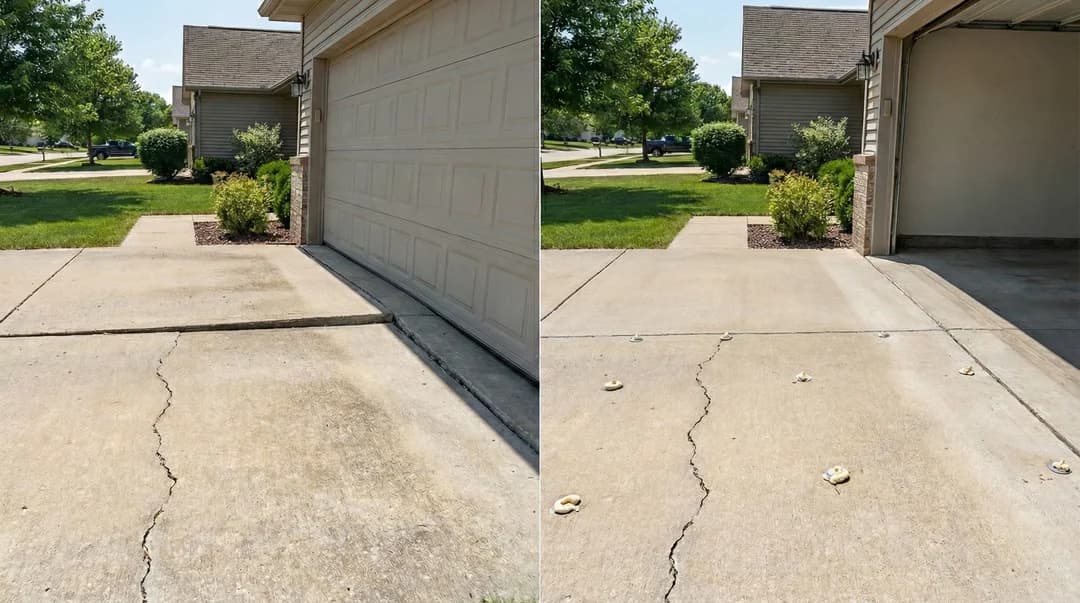
The Unique Vulnerability of Detached Garage Foundations
Unlike your home’s main foundation, which typically rests on deep footings extending well below the frost line, detached garages are frequently built on "floating slabs" or monolithic pads with shallow thickened edges. While cost-effective during construction, this engineering choice makes them significantly more sensitive to subsoil volatility. Without the anchoring weight of a full second story or deep frost walls, these structures are prone to "frost heave"—a phenomenon where freezing soil expands and lifts the slab unevenly (EcoHome, "Floating Slab on Grade Foundations"). This movement is often exacerbated by poor perimeter drainage, which allows water to pool and saturate the soil beneath the slab, creating a cycle of expansion and contraction that destabilizes the structure year after year.
For the preservationist homeowner, identifying the early warning signs of this differential settlement is critical to preventing catastrophic failure. You may notice distinct symptoms that differ from standard wear and tear:
Rotational Tilt: The floor may not just sink but "tip" away from the driveway, creating a hazardous lip or separation at the apron.
Structural Jamming: Doors and windows that suddenly stick or fail to latch are often the first indicators that the frame is twisting due to slab movement.
Stair-step Cracking: Diagonal cracks in brickwork or concrete block walls suggest that one corner of the garage is settling faster than the rest.
A common mistake is attempting to mask these issues with self-leveling compounds or cosmetic concrete patches. These "band-aid" fixes fail because they add dead weight to soil that is already struggling to support the structure, often accelerating the sinking process. Furthermore, traditional mudjacking adds significant mass—up to 100 lbs per cubic foot—which can further compress weak soil (Concrete PolyFix, "Mudjacking vs. Polyurethane"). True structural integrity requires stabilizing the soil itself, not just smoothing the surface. Modern polyurethane injection offers a precision engineering solution, stabilizing the subgrade with a material that is lightweight and hydrophobic, ensuring repairs can last 20 to 50 years (Superior PolyLift, "How Long Does Polyurethane Foam Last?").
The Black Birch 'Root Cause' Method: How Polyfoam Grout Works
For the preservationist homeowner, correcting a sinking detached garage is not merely about aesthetics—it is about restoring the structural narrative of the property. While traditional mudjacking treats the symptom by pumping heavy slurry under a slab, our approach uses high-density polyfoam garage floor leveling to address the root cause: the compromised soil stability underneath.
The process begins with precision, not destruction. We drill penny-sized injection ports (approximately 5/8") through the concrete, maintaining the integrity of your vintage finish. Through these ports, we inject a two-part polymer liquid. This is where the engineering distinction becomes clear: unlike cementitious grout, which piles heavy material onto already weak soil, polyurethane foam undergoes a rapid chemical reaction that creates expansive force without significant added weight.
Phase 1: Void Filling and Soil Densification
Before any lifting occurs, the expanding foam seeks out voids caused by years of soil erosion or rodent activity. As it expands, it does not merely occupy space; it actively compacts the surrounding loose soil. Recent geotechnical studies have demonstrated that polyurethane injection creates a "partial volumetric replacement" that significantly increases the shear resistance of the soil zone (Onyang, 'Enhancement of the Behavior...'). This structural soil stabilization creates a dense, load-bearing sub-base capable of supporting the garage floor long-term.
Phase 2: The Hydraulic Lift
Once the soil is densified, the continuing expansion of the foam generates a hydraulic lift, raising the slab back to level with 1/8-inch precision. This method of concrete void filling and lifting is superior for detached garages because the material is hydrophobic and lightweight. Engineering data confirms that polyurethane foam effectively limits settlement without adding the burden of heavy concrete grout, which can weigh over 100 lbs per cubic foot (HMI, 'Choosing the Right Polyurethane Foam'). By choosing this non-invasive repair, you are effectively "underpinning" your floor with a material that will not wash away, ensuring your garage remains level for decades to come.
Strength Test: Can Polyurethane Foam Support Heavy Vehicles?
For the "Preservationist" homeowner, the idea of injecting foam under a settling detached garage often triggers logical skepticism. We associate "foam" with softness—mattresses, pillows, or packing peanuts. It feels counterintuitive to trust a lightweight material to hold up a Ford F-150, a woodworking lathe, or a 3-ton hydraulic lift. However, geotechnical polyurethane is not consumer-grade spray foam; it is a high-density structural polymer engineered specifically for load-bearing stability.
The engineering reality lies in the compressive strength data. High-density polyurethane grout used for slab lifting typically achieves a compressive strength of 80 to 100 PSI (Acme Concrete, 'Compressive Strength'). While "100 PSI" might sound low compared to concrete’s 3,000 PSI, it is structurally massive in this context. To visualize this: 100 PSI translates to supporting approximately 14,000 pounds per square foot (Superior PolyLift, 'Foam Strength'). Given that a standard passenger vehicle exerts only about 30 to 35 PSI through its tires, the foam provides a safety factor of nearly 300% for typical garage loads.
Why "Stronger" Isn't Always Better
A common misconception is that mudjacking (cement slurry) is superior because it hardens to a higher PSI (often 2,000+). However, this brute-force strength comes with a structural penalty: weight. Traditional mudjacking slurry weighs between 100 and 150 pounds per cubic foot, significantly burdening the underlying soil that has already failed to support your garage (Superior PolyLift, 'Load-Bearing Strength').
In contrast, high-density polyurethane weighs only 3 to 5 pounds per cubic foot. This offers a smart engineering advantage:
Zero Added Stress: It fills voids and lifts the slab without adding significant mass to the compromised subgrade.
Hydrophobic Stability: Unlike cement slurries that can degrade or wash out over time, structural foam is hydro-insensitive, meaning it cures fully even in water-saturated soils and remains dimensionally stable.
Precision Support: The foam expands to fill 100% of the void, ensuring even weight distribution for heavy machinery or vehicles.
For the homeowner looking to preserve their garage for decades of heavy use, polyjacking offers a solution that is tough enough for the weight of daily life but smart enough not to repeat the failures of the past.
Cost and Time Analysis: Injection vs. Full Slab Replacement
For the preservationist homeowner, the goal is often to maintain the character and structural integrity of a property without unnecessary waste. When addressing a detached garage foundation showing signs of settlement, the traditional "rip-and-replace" method is frequently a disproportionate response. Smart engineering offers a more precise alternative: polyfoam garage floor leveling. This approach not only respects the existing architecture but also offers compelling advantages in both capital expenditure and project duration.
The Financial Reality: Repair vs. Replace
The most immediate differentiator is direct cost. Full slab replacement is a labor-intensive process involving heavy demolition, debris removal, site preparation, and the pouring of new concrete. In contrast, expanding foam grout injection utilizes the existing slab, restoring its level and stability from beneath. Industry data indicates that lifting and leveling an existing slab with polyurethane typically costs 50% to 70% less than a full replacement (Lift Up Concrete Lifting, "The Cost-Benefit Analysis"). By eliminating the need for raw materials and extensive labor crews, structural soil stabilization becomes the pragmatic financial choice.
The Hidden Costs of Demolition
Beyond the quote on paper, replacement carries "hidden" costs that preservationists are keen to avoid. A full tear-out is invasive. It often requires heavy machinery that can damage adjacent driveways, established landscaping, and irrigation systems. Furthermore, the environmental toll is significant; concrete demolition generates substantial waste that incurs landfill fees and contributes to carbon emissions. Polyurethane slab lifting is a non-invasive concrete repair method that leaves the surrounding property—and your landscaping—untouched, avoiding the secondary restoration costs associated with heavy construction (Pacific BC, "Polyurethane Concrete Lifting").
Timeline Advantage: Hours vs. Weeks
Time is perhaps the most undervalued currency in construction projects. A traditional concrete pour requires a curing period that can render a garage unusable for weeks. New concrete typically needs up to 28 days to reach full structural strength. Conversely, the chemical reaction in polyjacking creates a rapid cure. A professional team can complete a sunken garage floor fix in a matter of hours, with the surface capable of supporting the weight of a vehicle within just 15 to 30 minutes of completion (KC Pier, "Why Polyjacking is Better"). This immediate return to service transforms a potentially month-long headache into a single morning's maintenance.
Longevity and Environment: Will the Floor Sink Again?
For the preservationist homeowner, the decision to repair rather than replace is driven by a desire to maintain the structural character of the property without inviting a recurring headache. A common (and valid) skepticism regarding non-invasive concrete repair is whether the solution is permanent. Unlike traditional "mudjacking"—which pumps a cementitious slurry that can shrink, wash away, or degrade over time—polyfoam garage floor leveling utilizes a material engineered for geological permanence.
The polyurethane foam used by Black Birch Contracting is chemically inert once cured. This means it does not rot, decay, or break down, regardless of soil acidity or the presence of microorganisms. In geotechnical engineering applications, high-density polyurethane is estimated to have a half-life exceeding 150 years, far outlasting the concrete it supports (CJGeo, "Polyurethane Grout for Ground Improvement"). By choosing expanding foam grout injection, you are not simply filling a void; you are installing a synthetic support system that remains stable indefinitely.
Furthermore, the primary culprit of detached garage settlement—water saturation—is actively managed by the material itself. The foam is hydrophobic, meaning it naturally repels water. During injection, the expanding foam displaces trapped water and cures into a rigid, waterproof barrier that prevents future soil softening and erosion (Helicon, "Polyurethane Foam Injection"). This structural soil stabilization ensures that the subgrade remains compacted and dry, eliminating the environmental variables that caused the sinking in the first place.
Because of this chemical stability and resistance to water, Black Birch Contracting can offer material lifespan guarantees that traditional cement slurry providers simply cannot match. While mudjacking materials are vulnerable to the same erosion cycles that damaged the original foundation, polyfoam remains a distinct, immutable solid (Superior Grouting, "Why Does Polyurethane Beat Cement"). For the pragmatic homeowner, this translates to a "one-and-done" investment that preserves the garage’s integrity for decades to come.
Addressing Severe Drainage and Erosion Issues
For the preservation-minded homeowner, discovering a sinking detached garage floor is often alarming, not just for the visible crack, but for what it implies about the ground beneath. While lifting the slab restores the visual line, it is merely half the battle. The root cause of settlement in detached structures is almost invariably water management failure, leading to soil erosion and sub-slab voids. Without correcting the drainage, even the most precise lift will eventually succumb to the same hydraulic forces that caused the initial failure.
This is where polyfoam garage floor leveling distinguishes itself from legacy repair methods like mudjacking. Beyond simply raising the concrete, the high-density polyurethane foam acts as a "void-filling" agent. When injected, the material expands aggressively—often 15 to 40 times its liquid volume—to penetrate weak soil zones and compact loose subgrade (Superior PolyLift, 'Weak Ground Conditions'). Unlike cementitious slurry, which can shrink or wash away, high-quality polyfoam is hydrophobic and chemically stable. It effectively seals the underground pathways where water previously eroded the soil, creating a water-resistant barrier that stabilizes the foundation against future moisture intrusion (Superior Grouting, 'High Water Table Areas').
However, engineering a permanent solution requires a holistic approach. We strongly recommend pairing expanding foam grout injection with specific exterior improvements to divert water away from the garage perimeter. This often includes:
Downspout Extensions: Ensuring roof runoff is discharged at least 4-6 feet away from the foundation.
Regrading: Adjusting the soil slope to prevent pooling against the slab edges.
French Drains: Installing subsurface drainage to manage hydrostatic pressure in water-heavy soils (Ingenious General Construction, 'Protect Your Home').
By combining non-invasive concrete repair with robust drainage correction, you protect the structural integrity of your garage without the waste and cost of a full demolition.
Conclusion: Save the Structure without the Trauma
For the homeowner who views their property as a long-term investment rather than a disposable asset, the choice between preservation and demolition is clear. Opting for polyfoam garage floor leveling is not merely a repair; it is a strategic act of ground improvement. Unlike traditional mudjacking, which adds significant weight to already compromised soil, high-density polyurethane is engineered to be lightweight—typically weighing only 2 to 4 pounds per cubic foot compared to the 100 pounds per cubic foot of cement slurry (Sealtite Insulation, "Mudjacking vs. Polyurethane Foam"). This ensures that while we correct the settlement, we do not overburden the weak subgrade that caused the issue in the first place.
The engineering case for this method is robust. This is not a temporary patch; it is a permanent structural enhancement. Modern structural foams are capable of supporting extreme loads, with some high-density formulations sustaining up to 14,000 pounds per square foot (Superior PolyLift, "Foam Strength for Large Foundations"). Furthermore, the speed of cure is unmatched in the construction industry. While poured concrete requires days or weeks to reach full capacity, polyurethane achieves 90% of its compressive strength within just 15 minutes of injection (Alchatek, "AP Lift 475"). This efficiency allows you to reclaim your garage immediately, avoiding the waste and disruption of a full tear-out.
Your detached garage likely has years of service left in it. Don't let a shifting foundation dictate a premature demolition. Contact Black Birch Contracting today for a structural assessment. Let us help you address the root cause of the settlement with precise structural soil stabilization, ensuring your floor remains level and your doors swing freely for decades to come.