The Diagnosis: Why Excavation is the Wrong Treatment for Settlement
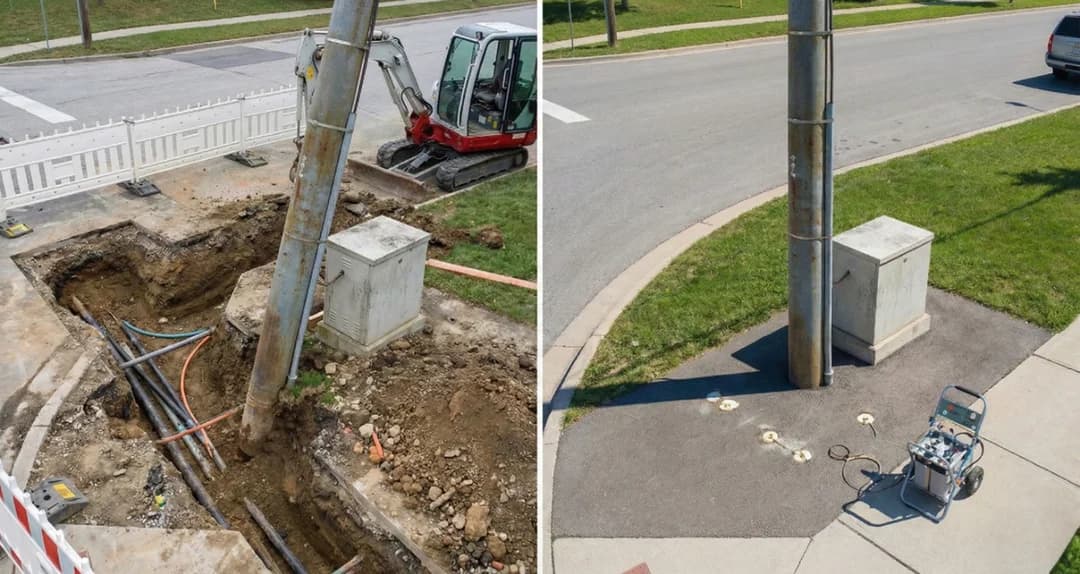
In the world of infrastructure maintenance, visible issues like leaning light poles, uneven utility pads, and gaps beneath concrete slabs are rarely just cosmetic problems. They are symptoms of a deeper "disease": hydrophobic soil instability and subsurface voids. When the ground beneath a utility box weakens, the heavy equipment above begins to sink, creating trip hazards and structural strain. Regrettably, the traditional prescription for these symptoms often involves a "brute force" approach that causes more trauma than the original injury.
Conventional repair methods typically require bringing in heavy excavators to tear out the existing concrete, dig up the compromised soil, and re-pour the foundation from scratch. This invasive process destroys landscaping, disrupts surrounding hardscapes, and can leave a site unusable for days or weeks. It is the equivalent of performing open-heart surgery to treat a minor arterial blockage—effective, perhaps, but excessively damaging and costly. As the industry evolves, the demand for less invasive methods is surging, with the trenchless rehabilitation market in North America projected to reach nearly $2 billion by 2025 (Fortune Business Insights, "North America Trenchless Pipe Rehabilitation Market").
At Black Birch Contracting, we operate as "infrastructure surgeons" rather than demolition crews. By utilizing polyfoam soil stabilization for utility infrastructure, we inject structural polymer grout through penny-sized holes directly into the compromised soil. This trenchless utility repair technique is minimally invasive, expanding to fill voids and densify loose earth without a single shovel hitting the ground. The high-density polyurethane (HDP) we use is engineered to stabilize weak ground conditions by increasing load-bearing capacity by 50-200%, ensuring a permanent cure rather than a temporary patch (Superior PolyLift, "Polyurethane Foam vs. Soil Issues").
Ignoring these signs of settlement carries significant risk beyond mere aesthetics. A leaning light pole or a shifted utility pad creates immediate liability; inadequate lighting or uneven surfaces are frequent contributors to premises liability claims against commercial property owners (Malowitz Law Firm, "2 Ways That Bad Lighting Can Lead to Premises Liability Claims"). By choosing non-invasive ground improvement, facility managers can mitigate these risks instantly, restoring safety and structural integrity in hours instead of days.
Surgical Precision: How Polyfoam Grout Stabilizes Heavy Structures
When a municipal utility box or a 50-foot light pole begins to tilt, the issue rarely stems from the concrete pad itself. The structural failure almost always originates deep underground, where loose or poorly compacted soil loses its ability to support the heavy load. Traditional repair methods—often involving excavation and total replacement—are costly, disruptive, and destructive to the surrounding landscape. By utilizing polyfoam soil stabilization for utility infrastructure, maintenance teams can address the root cause of settlement with surgical precision, eliminating the need for invasive digging.
The science behind this process relies on expanding polyurethane foam injection. Technicians inject a two-component structural polymer through small, penny-sized ports drilled directly into the concrete pad. Once the liquid resin enters the soil strata, it undergoes a rapid exothermic reaction, expanding up to 30 times its original liquid volume within seconds (Superior PolyLift, "How Polyurethane Foam Stabilizes"). This massive expansion does more than simply fill voids; it exerts controlled, multi-directional pressure that compacts loose soil particles outward, effectively densifying the weak ground into a rigid, load-bearing matrix.
This method is particularly effective for hydrophobic soil stabilization in areas with high water tables. Unlike cementitious grouts that can wash away or degrade in moisture, high-density polyurethane is water-resistant. It aggressively displaces standing water during injection and cures to form a permanent, dimensionally stable sub-base that will not break down over time (Superior Grouting, "Using Polyurethane Foam"). This capability is critical for utility pad void filling, as it prevents future erosion and freeze-thaw cycles from undermining the repair.
Ultimately, this trenchless approach transforms the soil beneath the infrastructure without disturbing the surface. By increasing the soil's bearing capacity and filling voids surgically, Black Birch Contracting can re-level critical assets like light poles and transformers in hours rather than days. This non-invasive ground improvement strategy ensures that public works directors and property managers can restore safety and structural integrity with minimal impact on their operational budgets or community aesthetics.
The Procedure: Leveling Leaning Poles and Filling Voids
Municipal directors and property managers frequently ask the core question: Can polyfoam injection fix leaning light poles permanently? The answer is yes, provided the underlying cause is soil instability rather than catastrophic structural failure of the pole itself. Unlike surface-level patches, high-density polyfoam targets the root cause—weak, non-load-bearing soil—by densifying the ground and creating a rigid, supportive base that prevents future settlement.
The process of light pole leveling without digging is a surgical, trenchless utility repair that minimizes disruption to surrounding infrastructure. The procedure follows a strict technical protocol:
Port Installation: Technicians drill small, dime-sized injection ports (typically 5/8”) directly through the adjacent concrete or asphalt, or drive injection rods into the soil around the pole base.
Injection and Expansion: A two-part structural polymer is injected into the compromised soil. Upon reaction, the material undergoes a rapid expansion, increasing its volume by up to 15 times (Alpha Foundations, "How Polyurethane Foam Injections Level Concrete").
Controlled Lift: As the expanding polyurethane foam injection fills voids, it exerts significant upward pressure. Technicians monitor laser levels in real-time, controlling the flow to incrementally lift the pole back to a plumb position without over-lifting.
For utility boxes and transformer pads, the focus shifts to utility pad void filling. Soil erosion often creates hidden caverns beneath these heavy slabs, causing them to tilt or crack. The polymer grout travels the path of least resistance, filling these voids to re-establish 100% contact between the slab and the subgrade. This process not only levels the infrastructure but also improves the soil's load-bearing capacity by 50-200% (Superior PolyLift, "Polyurethane Foam vs. Soil Issues").
The permanence of this solution is rooted in the material's chemical properties. Once cured, the polymer is inert and hydrophobic, meaning it naturally repels water and forms a barrier against future erosion. Unlike cementitious mudjacking slurry, which can degrade or wash away, cured polyurethane foam retains its structural integrity indefinitely, with a service life often exceeding 20 to 30 years (Superior PolyLift, "Polyurethane Foam vs. Soil Issues"). This makes polyfoam soil stabilization for utility infrastructure a capital improvement rather than a temporary maintenance fix.
Operating Conditions: Water, Groundwater, and Environmental Safety
One of the most common concerns for municipal directors and property managers is the environmental impact of injecting foreign materials into the soil, particularly near water tables or sensitive ecosystems. When stabilizing utility infrastructure, it is critical to ensure that the solution does not leach harmful chemicals or degrade water quality.
Modern structural polymer grouts are engineered to be chemically inert once cured. This means that after the initial reaction—which typically completes within minutes—the foam becomes a solid, stable material that does not break down or release toxic byproducts into the surrounding soil (Groundworks, "Environmental Impact"). Many high-quality polyurethane formulations meet NSF/ANSI 61 certification standards, the same rigorous safety benchmark used for materials that contact drinking water (Alchatek, "Is Polyurethane Stabilization Friendly?"). This makes the method viable for use near storm drains, aquifers, and protected wetlands where traditional concrete slurry might pose pH or contamination risks.
Beyond safety, operational efficiency in wet conditions is a major advantage of this trenchless method. Traditional soil compaction often fails in saturated ground, but hydrophobic polyfoam is specifically designed to perform in these environments:
Water Displacement: Unlike hydrophilic materials that absorb water and can become spongy, hydrophobic grout aggressively repels water. It pushes moisture out of the void space as it expands, ensuring a rigid cure even in waterlogged soil (Aquaprufe, "Hydrophilic VS. Hydrophobic Polyurethane").
No Dewatering Required: Because the chemical reaction is not inhibited by moisture, crews do not need to pump standing water out of utility vaults or trenches before injection. The foam naturally densifies loose, saturated soil, effectively sealing it against future infiltration (EagleLIFT, "Mitigating Groundwater Migration").
This capability allows maintenance teams to level light poles and stabilize utility pads year-round, regardless of recent rainfall or high groundwater levels, significantly reducing project delays and site preparation costs.
Post-Op Recovery: Cure Times and Downtime Reduction
For municipal directors and property managers, the "hidden" cost of infrastructure repair is often the downtime. Traditional excavation for utility box stabilization or light pole leveling involves a disruptive sequence: digging, pouring new concrete, and waiting. The most critical differentiator between polyfoam soil stabilization and traditional concrete replacement is the chemical cure time, which directly dictates how quickly assets can return to service.
The Concrete Bottleneck vs. Polyfoam Speed
New concrete pads or pilings are bound by the physics of hydration. According to industry standards, concrete requires a 28-day cycle to reach its full design strength (ACI Committee 308, 'Guide to External Curing'). While "green" concrete can bear some weight earlier, placing heavy utility transformers or subjecting a light pole to wind shear loads prematurely risks structural failure. This waiting period necessitates extended lane closures, safety barriers, and prolonged lighting outages.
In contrast, hydrophobic polyfoam grout is engineered for rapid deployment. The expanding structural polymer completes its chemical reaction and achieves 90% of its compressive strength within 15 to 30 minutes of injection (Sabri et al., 'Soil Injection Technology'). This allows maintenance crews to level a settled pad, verify stability, and remove traffic control devices in a single morning. For commercial properties, this means parking lots and walkways remain accessible, mitigating liability risks associated with uneven surfaces or unlit areas.
Eliminating Site Restoration
Beyond speed, the non-invasive nature of this method preserves the surrounding environment. Excavation inherently destroys landscaping, hardscape, and irrigation lines, leading to restoration costs that can exceed the repair itself. Trenchless technologies like polyfoam injection significantly reduce the carbon footprint and site disruption compared to open-cut methods (Kucera et al., 'Comparison of Trenchless and Excavation'). Because the injection ports are penny-sized and the equipment is mobile, the landscape remains pristine. There is no need for re-sodding, asphalt patching, or expensive post-project clean-up, ensuring the public right-of-way is visually and functionally restored immediately upon crew departure.
The Financial Anatomy: Cost Comparison and ROI
For municipal directors and property managers, the decision to repair infrastructure often hinges on a single metric: the bottom line. However, the true cost of utility maintenance extends far beyond the initial price of materials. When analyzing polyfoam soil stabilization for utility infrastructure versus traditional concrete replacement, the fiscal data reveals a stark contrast between surface-level pricing and total project expenditure.
The most immediate advantage of polyfoam injection is the direct capital savings. Industry projections for 2025 indicate that concrete lifting and leveling services are typically 50% to 70% less expensive than the cost of full demolition and replacement (A-1 Concrete Leveling, "The Ultimate Guide"). This significant margin exists because expanding polyurethane foam injection eliminates the labor-intensive need to excavate, remove, and haul away tons of failed concrete. By preserving the existing utility pads and light pole bases, you effectively bypass the most expensive line items of a construction budget.
The "Iceberg" of Hidden Replacement Costs
While the direct savings are substantial, the hidden costs of traditional excavation often derail public works budgets. A holistic financial analysis must account for the indirect expenses that accompany the "rip-and-replace" method:
Operational Downtime: Traditional excavation can leave utility access points or parking lot lights out of commission for days or weeks. In contrast, trenchless utility repair allows for immediate load-bearing use, often within 15 minutes of injection. Extended project delays from traditional methods can increase overall project costs by an estimated 20% due to labor overruns and management overhead (Grainge, "Hidden Costs").
Environmental & Disposal Fees: The logistics of removing old concrete involves heavy machinery and rising landfill tipping fees. Polyfoam injection is a zero-waste process that avoids these disposal costs entirely, minimizing the project's carbon footprint while preserving the surrounding landscape (Superior Grouting, "Environmental Benefits").
Landscape Restoration: Excavation rarely stays contained. It frequently damages adjacent sod, irrigation lines, and electrical conduits, necessitating costly remediation work that infrastructure settlement repair via injection avoids.
By choosing Black Birch Contracting for non-invasive ground improvement, facility managers are not just repairing a single asset; they are protecting their annual maintenance budget. The ability to stabilize loose soil and level light poles without digging transforms what would be a capital-intensive construction project into a manageable maintenance task, delivering a Return on Investment (ROI) that traditional methods cannot match.
Do not let unstable soil beneath utility boxes or light poles turn into a safety hazard or liability issue. Contact Black Birch Contracting today to schedule a consultation and learn how our trenchless polyfoam solutions can stabilize critical infrastructure quickly, permanently, and without excavation.