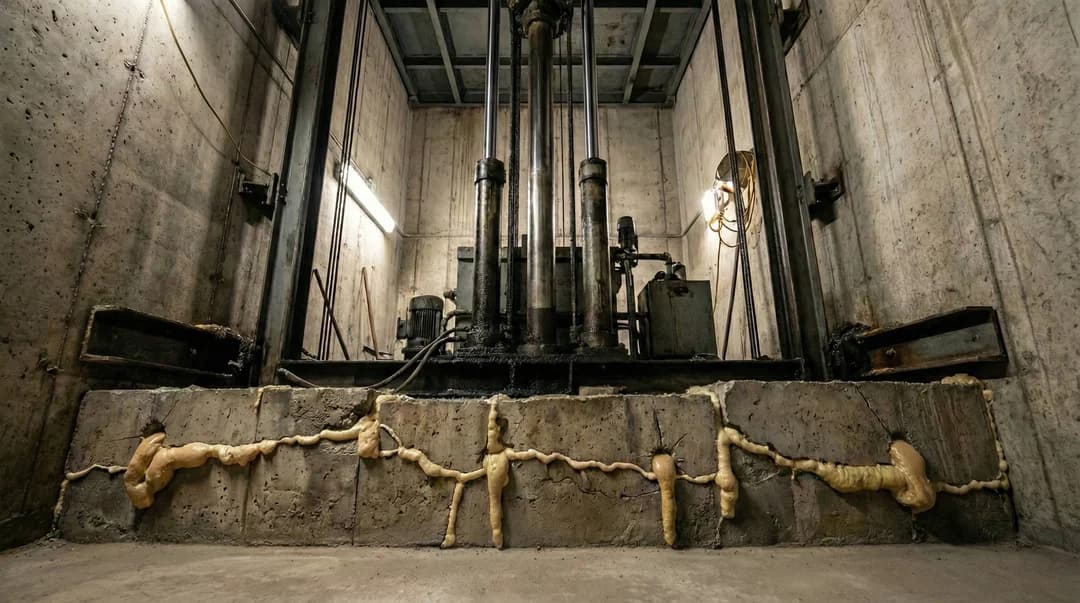
The Invisible Threat Beneath the Cab: Understanding Elevator Pit Voids
While most facility managers prioritize the mechanical maintenance of cables and pulleys, a more insidious structural threat often goes unnoticed until safety inspections fail: the destabilization of the elevator pit foundation. Unlike static building columns, elevator shafts are subjected to unique dynamic loading cycles. The constant acceleration, deceleration, and braking forces of the cab transmit low-frequency vibrations directly into the pit slab. Over time, these dynamic forces can cause loose granular soils beneath the concrete to rearrange and densify, a process known as vibration-induced settlement (Massarsch and Fellenius, "Ground Vibrations from Pile and Sheet Pile Driving").
When the soil consolidates, it pulls away from the underside of the pit floor, creating a hidden void. This loss of support is critical because elevator guide rails are frequently anchored to the pit floor. Even minor differential settlement—often less than half an inch—can torque the guide rails out of parallel alignment. The symptoms are rarely interpreted as foundation issues initially; instead, they manifest as "phantom" mechanical problems: persistent door jamming, uneven leveling at floors, or increased friction noise during operation. If left unaddressed, this differential settlement can lead to significant structural imbalances and costly compliance failures (Vertex Companies, "Differential Settlement in Buildings").
Black Birch Contracting specializes in diagnosing these deep-seated geotechnical discrepancies before they require catastrophic intervention. Rather than disrupting building operations with invasive demolition and re-pouring of the pit slab, we utilize deep-injection structural polyurethane foam. This method involves drilling penny-sized ports through the existing concrete and injecting a high-density polymer.
The expanding foam serves a dual purpose: first, it aggressively fills the void, re-establishing 100% contact with the load-bearing slab. Second, the expansion force compacts the underlying weak soil strata, effectively stabilizing the subgrade against future vibration damage. This trenchless approach allows for rapid remediation, often curing within an hour to minimize downtime for commercial tenants (Helicon, "Polyurethane Foam Injection | Pros and Cons Explained"). By addressing the geotechnical root cause rather than just the mechanical symptoms, we ensure long-term stability for one of the building's most critical assets.
Surgical Precision vs. Brute Force: The Impact on Operational Downtime
For commercial facility managers, the prospect of elevator pit stabilization often conjures nightmares of jackhammers, dust barriers, and weeks of "Out of Order" signs. Traditional concrete underpinning is inherently intrusive; it typically requires excavation to reach the foundation footing, necessitating heavy machinery that disrupts building operations. Beyond the noise, the chemistry of concrete dictates the schedule. Standard concrete underpinning can require up to 28 days to reach full load-bearing capacity, forcing extended shutdowns that result in lost tenant productivity and increased liability risks (Highways Today, "Elevator Maintenance in Commercial Buildings").
In contrast, elevator shaft void filling with polyfoam functions more like microsurgery than construction. The process utilizes structural polyurethane foam injection, requiring only small, 5/8-inch injection ports drilled through the existing slab. There is no excavation and no need to remove the elevator cab or motor. Once injected, the high-density polymer expands to fill voids and compact weak soil, creating a rigid, load-bearing sub-base without altering the shaft's dimensions.
The "Zero-Downtime" advantage lies in the material's rapid reaction time. Unlike concrete's weeks-long cure cycle, expanding polyurethane resin is chemically engineered to reach 90% of its maximum compressive strength within just 15 minutes of injection (Al Naddaf et al., "Soil Injection Technology Using an Expandable Polyurethane Resin"). This allows for immediate verification of geotechnical foam grouting results. In most scenarios, the elevator pit is stabilized, the ports are grouted, and the lift is certified to return to service within the same business day. This non-invasive elevator shaft repair ensures that while the structural integrity of the building is being restored, the daily rhythm of your commercial tenants remains virtually undisturbed.
Strength Under Pressure: Can Foam Handle the Dynamic Load?
A common hesitation among facility managers is the intuitive belief that only concrete can support the immense weight and movement of a commercial elevator system. However, the "foam" utilized in geotechnical applications is chemically distinct from the soft material found in furniture. Specifically, high-density structural polyurethane is engineered for extreme load-bearing capacity, with certain formulations capable of supporting over 14,000 pounds per square foot (Alchatek, "AP Lift 460"). This compressive strength allows it to easily withstand the static weight of the elevator pit slab and the rails, often outperforming the original soil base in terms of consistency and stability.
Beyond static strength, elevator shafts present a unique challenge: dynamic loading. The constant starting, stopping, and braking of an elevator car transmits significant vibration through the guiderails into the foundation. While concrete is rigid and prone to micro-cracking under repetitive high-frequency stress, structural polyurethane acts as a non-linear viscoelastic material. This property allows it to dampen shocks and dissipate mechanical energy, effectively absorbing the vibrations that would otherwise compromise the soil structure (MDPI, "Application of Polyurethane Foam"). This damping effect makes polyfoam an ideal solution for active shafts where structural integrity must be maintained alongside constant kinetic movement.
The application of this material goes beyond simple void filling. Through a process known as deep injection soil stabilization, technicians inject the polymer at multiple depths below the pit slab. The foam expands with significant force, compacting and densifying the weak "bulb" of soil responsible for the initial settlement (Dalinghaus, "Pros and Cons of Deep Injection"). This creates a permanent, densified subgrade that locks the slab in place, ensuring compliance with elevator safety codes without the weeks of downtime associated with pouring new concrete.
Non-Invasive Access: Repairing Without Removing the Cab
For facility managers and property owners, the most daunting aspect of elevator shaft repair is often the operational burden of downtime. Traditional foundation remediation often requires decommissioning the elevator, removing the cab, and excavating the pit floor—a process that can disrupt building operations for weeks. However, the logistical advantage of structural polyurethane foam injection lies in its ability to bypass these intrusive measures entirely. By utilizing a trenchless application method, technicians can stabilize the soil and fill voids directly beneath the shaft without displacing the elevator car or its critical mechanical components.
The injection process is designed for precision and minimal impact. Technicians drill a series of small, penny-sized holes—typically 5/8 of an inch in diameter—through the concrete pit floor (Hargrave, "Benefits of Polyurethane"). Because the equipment utilizes long, flexible hoses, these injection ports are often accessible by simply raising the elevator cab to a higher floor, eliminating the need for crane removal or heavy machinery. Once the high-density polymer is injected, it expands rapidly to fill voids and compact loose soil, curing to 95% capacity within as little as 20 minutes (NCFI, "Polyurethane Foamjacking"). This rapid cure time allows for immediate load testing and return to service.
In scenarios where the pit floor is physically inaccessible due to complex machinery or safety constraints, the geometry of the building often permits an alternative approach. Void filling can frequently be performed from adjacent rooms or the building exterior by drilling angled injection paths that reach beneath the shaft. This versatility ensures that the existing electrical systems, hydraulic pistons, and buffer springs located in the pit remain undisturbed. By preserving these sensitive mechanical elements, facility managers avoid the compounding costs of recalibration and equipment repair that typically accompany invasive excavation methods.
Waterproofing the Pit: The Role of Hydro-Insensitive Foam
In the lifecycle of many commercial high-rises, elevator pits frequently become the unintended collection points for groundwater. Because these shafts often extend below the water table, they act as sumps, drawing in moisture through cold joints and micro-fractures in the concrete. This constant ingress creates a compounding structural problem: as water moves through the soil beneath the pit, it slowly erodes the fine particulates supporting the foundation, leading to voids and differential settlement. For facility managers, this manifests not only as compliance failures during inspections but as physical misalignments in the elevator tracks.
To address this, elevator shaft void filling with polyfoam utilizes a specific class of material known as hydro-insensitive polyurethane. Unlike standard cementitious grouts, which can dilute, wash away, or fail to cure properly in saturated environments, hydro-insensitive foams are engineered to maintain their chemical integrity in the presence of water. Research into expansive soil stabilization confirms that hydrophobic (water-repelling) polyurethane foams can effectively reduce soil swelling potential and maintain high compressive strength even when injected into moisture-rich environments (Al-Atroush and Sebaey, "A Novel Application of the Hydrophobic Polyurethane Foam"). This distinct chemical property allows the material to react and expand without absorbing the surrounding water, ensuring the cured foam retains the density required to support heavy structural loads.
The application process provides a dual-benefit mechanism that is critical for long-term repair. As the high-density liquid polymer is injected into the void, it undergoes a rapid exothermic reaction. This expansion does more than just fill the empty space; it actively displaces standing water, pushing it away from the structure while simultaneously compacting the surrounding loose soil. The result is a rigid, closed-cell foam barrier that effectively waterproofs the underside of the pit while re-establishing the soil’s bearing capacity. By creating this impermeable seal, building owners prevent the cycle of soil washout that typically causes recurring voids, securing both the foundation and the elevator’s operational compliance for the long term.
The Bottom Line: Compliance, Cost, and Continuity
For facility managers, the decision to utilize elevator shaft void filling with polyfoam goes beyond simple concrete repair; it is a strategic move to ensure business continuity and regulatory adherence. When differential settlement occurs beneath an elevator pit, it does more than crack the floor—it compromises the verticality of the guide rails. According to the Safety Code for Elevators and Escalators, specifically the 2022 update, even minor deviations in rail alignment can trigger emergency safety stops or fail compliance audits regarding sill-to-car thresholds (ANSI, "ASME A17.1-2022 Safety Code"). Structural polyurethane foam injection corrects this deep-seated issue by expanding into the soil matrix, lifting the pit slab back to its original horizon with roughly 1/8-inch precision, ensuring the rails return to plumb without manual realignment.
The financial argument for this method centers on "Total Project Cost" rather than line-item material expenses. While the raw chemical costs for geotechnical foam can be higher than traditional cementitious mudjacking, the operational savings are drastic. Traditional repair requires excavation and demolition, often shutting down a commercial building's vertical transport for weeks. In contrast, the global market for polyurethane injections is rapidly expanding, projected to exceed $1.6 billion by 2024, largely driven by the demand for "cost-effective and time-saving repair solutions" that minimize facility downtime (Cognitive Market Research, "Polyurethane Injections Market 2024"). By choosing non-invasive elevator shaft repair, building owners avoid the massive revenue loss associated with tenant displacement or extended elevator service interruptions.
Ultimately, this approach transforms a potential crisis into a manageable maintenance event. A stable foundation ensures that the elevator system passes rigorous load and speed safety inspections, protecting both the asset and the passengers. We encourage building engineers to view poly lifting commercial buildings not just as a fix for cracks, but as a critical continuity strategy. Addressing elevator pit stabilization proactively with deep injection prevents catastrophic compliance failures and keeps your building moving.
Do not let hidden elevator pit voids compromise safety compliance or disrupt building operations. Contact Black Birch Contracting to schedule a consultation and secure your elevator foundation with fast, non-invasive polyfoam stabilization.