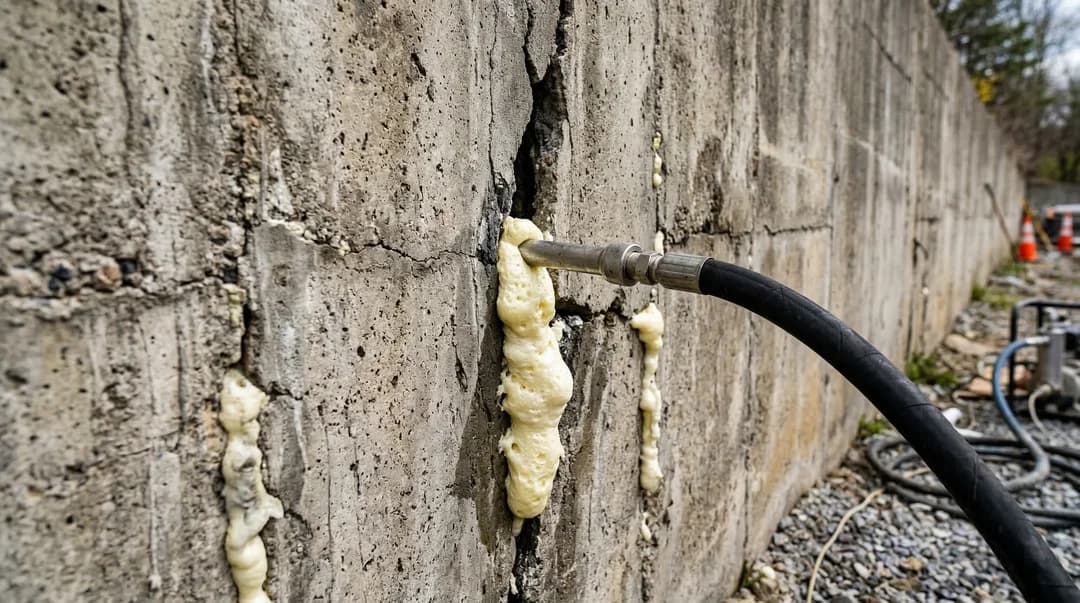
What is Polyurethane Injection and How Does the Process Work?
When dealing with sinking slabs, settling walkways, or uneven structural floors, property owners and facility managers often weigh the advantages of polyurethane injection against more disruptive alternatives. Often referred to as "polyjacking" or polyurethane concrete leveling, this technique is a modern, precision-based geotechnical solution designed to raise and stabilize sunken concrete. Unlike traditional concrete repair methods—which frequently involve invasive excavation, costly full-depth replacements, or pumping heavy cement slurries—polyurethane foam injection utilizes advanced polymer chemistry to stabilize the earth directly beneath the concrete.
The step-by-step process is engineered for speed and precise control, making it an ideal choice for both non-invasive foundation repair in residential settings and large-scale structural stabilization in commercial civil contracting. The procedure generally follows these key steps:
Strategic Drilling: Technicians drill small, penny-sized holes (usually about 5/8-inch in diameter) directly through the sunken concrete slab. This is significantly smaller than the large injection ports required for older techniques, highlighting one of the major operational benefits when comparing mudjacking vs polyjacking.
Injection of Two-Part Polymers: Specialized, high-pressure equipment injects a two-component liquid polymer through the drilled holes and deep into the subgrade below.
Rapid Expansion and Void Filling: Once the liquid components mix beneath the surface, an exothermic reaction occurs. The high-density polyfoam rapidly expands, automatically seeking out the path of least resistance to fill microscopic voids, crevices, and soil washouts.
Lifting and Curing: As the foam expands, it exerts precise, upward hydrostatic pressure that gently lifts the concrete back to its original grade. The foam sets quickly, curing to a traffic-ready state in approximately 15 minutes (HomeGuide, "How Much Does Polyjacking Cost?").
This modern approach does more than just treat the symptom of a sinking slab; it actively engineers the soil, which is crucial for lasting foundation crack repair. As the foam expands, it displaces existing groundwater and compacts loose soil particles, increasing local soil confinement and drastically improving the composite stiffness and load-bearing capacity of the earth (HMI, "Field Applications of Structural Polyurethane"). Furthermore, modern geotechnical foams cure to an incredibly durable state. High-grade structural foams can provide compressive strength equivalent to supporting 7,200 to 14,000 pounds per square foot (Powell, "Concrete Leveling with Polyurethane Foam"). Ultimately, this process delivers immediate, precise lifting and complete subterranean support that lasts for decades, outperforming traditional approaches that add unnecessary weight to already compromised soil.
Mudjacking vs Polyjacking: Leaving Traditional Concrete Repair Methods Behind
For decades, property owners and civil contractors relied on mudjacking as the default solution for concrete settlement. However, this traditional concrete repair method is rapidly becoming obsolete. Mudjacking involves pumping a messy, thick slurry of water, soil, and cement beneath a sunken slab to force it upward. While it technically works as a temporary bandage-style fix, it completely ignores the underlying root cause of foundation and slab settlement: weak or compromised soil. As the heavy slurry degrades over time, the structural issues inevitably return. Fortunately, modern engineering has introduced a superior alternative. Polyurethane concrete leveling—often referred to as polyjacking—replaces the outdated, invasive nature of mudjacking with a clean, advanced, and permanent structural stabilization technique, preventing the need for a costly, full-scale concrete replacement.
One of the most critical advantages of polyurethane injection over traditional repair methods is the dramatic difference in material weight and how it interacts with the earth. When choosing between these methods, several major contrasts emerge:
Soil Burden and Weight: When mudjacking slurry is pumped under a slab, it introduces massive weight to an already failing subgrade. Traditional slurry mixtures can weigh up to 100 pounds per cubic foot, heavily burdening unstable soil and practically guaranteeing future settlement (Superior PolyLift, "Polyurethane vs Mudjacking"). In stark contrast, high-density polyfoam is incredibly lightweight, adding only 2 to 4 pounds per cubic foot while still achieving immense compressive strength (Concrete PolyFix, "Mudjacking vs. Polyurethane Lifting"). This enables a true non-invasive foundation repair that stabilizes the soil without overburdening it.
Invasiveness and Aesthetics: Pumping thick slurry requires drilling large, highly visible holes—typically 1 to 2 inches in diameter—that weaken the slab and leave unsightly patches. Conversely, targeted polyurethane foam injection requires holes as small as 3/8 of an inch, making the repair virtually invisible and preserving the concrete's aesthetic integrity (PolyMagic, "Concrete Leveling Foam vs. Mudjacking").
Permanent Engineering vs. Temporary Fix: Polyurethane acts as a permanent engineering solution. Once injected, the polymer reacts rapidly, expanding to fill voids and fissures while aggressively bonding with the soil. Unlike mud-based mixtures that wash away with groundwater erosion, polyurethane resin is completely hydrophobic and acts as a permanent watertight seal against future water ingress (Safan et al., "Evaluation of polyurethane resin injection for concrete leak repair").
Finally, polyjacking significantly outperforms traditional methods in curing speed. A mudjacking application can take anywhere from 24 to 72 hours to fully cure, forcing prolonged facility downtime or driveway closures. High-density polyurethane, however, reaches 90% of its full compressive strength and is traffic-ready in as little as 15 to 30 minutes ('58 Foundations, "Polyurethane Foam Lifting vs. Mudjacking"). For facility managers looking for fast foundation crack repair and concrete settlement solutions, this means absolute efficiency—resolving the problem with zero messy cleanup and ensuring an immediate return to service.
Advantage 1: Non-Invasive Foundation Repair with Minimal Disruption
When dealing with concrete settlement or sinking structural elements, property owners and facility managers often dread the chaotic, messy reality of traditional repair methods. One of the primary advantages of polyurethane injection is its ability to provide structural stabilization without the heavy excavation, large crews, and destructive machinery that traditionally halt daily operations for weeks. This method completely transforms the repair process, offering a truly non-invasive foundation repair solution that respects both your property and your schedule.
The low-impact nature of high-density polyfoam means contractors no longer need to bring in backhoes or demolish existing slabs to resolve underlying soil issues. Instead of excavating the foundation, technicians drill precise, dime-sized holes directly into the affected concrete. Through these minimal entry points, the expanding polymer is injected directly into the subgrade to fill voids and lift the slab from below. According to industry expert Jay Silver, this streamlined approach allows teams to lift and stabilize surfaces "in just a few hours, without excavation or heavy equipment" (Silver, "Polyurethane Foam Lifting Florida"). This drastically reduces the site mess and landscape destruction typically associated with legacy concrete repair.
When comparing mudjacking vs polyjacking, the disruption factor is a major differentiator. Here is how polyurethane foam injection provides an immediate return to service:
Rapid Curing Speeds: While traditional cement slurries can take days to dry, polyurethane concrete leveling material hardens incredibly fast. The foam reaches its necessary structural strength within 15 to 30 minutes (Leman, "Concrete Leveling Methods: Mudjacking vs Polyurethane Foam Injection").
Uninterrupted Operations: Because the material cures almost instantly, heavy vehicles, forklifts, and pedestrian foot traffic can resume regular daily property use immediately after the repair is complete.
Pristine Job Sites: There are no piles of excavated dirt, no messy slurry washouts, and no heavy tire tracks ruining commercial lawns or residential gardens.
For civil contractors and commercial property managers, eliminating downtime is just as critical as the foundation crack repair itself. By choosing polyurethane injection over traditional concrete repair methods, you can secure a permanent, waterproof leveling solution—all completed in a single afternoon.
Advantage 2: Extreme Durability and a Permanent Lifespan
When investing in foundation crack repair or structural stabilization, property owners and civil contractors share a common concern: How long will this repair actually last? Unlike outdated techniques that offer only a temporary bandage, polyurethane concrete leveling provides a permanent solution. Once injected, high-density polyfoam cures into an inert, rigid state that is engineered to endure for decades, often matching or exceeding the lifespan of the concrete slab itself (HMI, "Commercial & Governmental Projects").
To understand exactly how this method guarantees long-term structural integrity, it is essential to look at the material's interaction with the subgrade. Polyurethane foam injection creates a closed-cell, hydro-insensitive barrier. This ensures that the cured material is completely immune to biological degradation and water damage. The key durability benefits include:
Immunity to Washout: The expanded foam is 100% waterproof. Regardless of future weather conditions, heavy rainfall, or poor site drainage, the material will not wash away or leach into the soil. State transportation departments regularly utilize this material to create permanent waterproof membranes beneath heavy-duty infrastructure (Superior PolyLift, "Solving Weak Ground Conditions").
Unchanging Volume: Polyurethane does not shrink, crack, or decompose over time, ensuring the ground beneath remains tightly compacted.
High Load-Bearing Capacity: Despite weighing only 2 to 4 pounds per cubic foot, the cured foam easily supports heavy structural and vehicular loads. Field studies on heavy-traffic infrastructure have demonstrated that polyurethane foam successfully reduces slab deflection by up to 60% (Gassko et al., "Performance of Settled Bridge-Approach Slabs").
The true advantages of polyurethane injection become especially clear when contrasted with traditional concrete repair methods. When weighing mudjacking vs polyjacking, traditional mudjacking relies on a heavy cementitious slurry made of soil, sand, and water. Because this mixture is permeable and structurally rigid but brittle, it eventually breaks down, cracks, and washes away under moisture exposure—typically failing and requiring rework within just two to five years (HMI, "Commercial & Governmental Projects").
By relying on a non-invasive foundation repair approach that utilizes moisture-proof materials, property managers eliminate the vicious cycle of re-settlement. Whether mitigating simple concrete settlement or executing complex commercial lifts, polyurethane guarantees that the foundation remains stable, protected, and level for a lifetime.
Advantage 3: Superior Long-Term Cost-Effectiveness
When evaluating foundation crack repair and structural stabilization, the true cost of a project extends far beyond the initial contractor quote. Property owners and facility managers must look at the lifetime return on investment (ROI). While traditional concrete repair methods might seem familiar, the financial advantages of polyurethane injection make it the clear frontrunner for sustainable, budget-friendly infrastructure management.
The financial superiority of polyurethane concrete leveling over traditional methods becomes evident when breaking down the direct and indirect cost savings:
Massive Upfront Savings vs. Replacement: Tearing out, removing, and repouring new concrete is a labor-intensive process that requires heavy machinery, extensive demolition, and costly material disposal. By preserving the existing slab and lifting it from beneath, high-density polyfoam injection can save property owners up to 70% compared to the steep costs of complete concrete replacement (SafeBasements, "Concrete Leveling Vs. Replacement: Which is Right For You?").
Zero Operational Downtime for Commercial Facilities: For commercial sites and civil infrastructure, the hidden costs of concrete repair lie in prolonged facility closures. Traditional concrete pouring projects take days to complete and cure. In contrast, non-invasive foundation repair using polyurethane foam cures incredibly fast. The treated slabs can safely handle heavy vehicle traffic within 15 minutes of application, ensuring that businesses suffer no lost revenue or interrupted logistics (Ogburn Construction, "How Much Does Polyurethane Foam Injection Cost?").
Eliminating the Cycle of Repeated Repairs: When analyzing mudjacking vs polyjacking, traditional mudjacking uses a heavy, water-absorbent cement slurry that is highly prone to washing out and eroding over time. Polyurethane foam, however, is a lightweight, hydrophobic material that compacts and permanently stabilizes the underlying soil without degrading (Superior PolyLift, "Polyurethane vs Mudjacking").
Ultimately, avoiding future secondary repairs is what truly elevates the lifetime ROI of this structural solution. By addressing the root cause of the soil settlement—without incurring heavy demolition fees or forcing business interruptions—polyurethane injection stands as the most economical and reliable long-term choice for modern concrete repair.
Advantage 4: Eco-Friendly Materials Safe for the Surrounding Soil
When considering traditional concrete repair methods, property owners and facility managers often worry about the environmental impact of the materials being pumped into the earth. However, one of the most significant advantages of polyurethane injection is the environmental safety of modern chemical formulations. Today's high-density polyfoam is specifically engineered to be eco-friendly, providing a highly sustainable solution for structural stabilization without compromising the surrounding ecosystem.
Unlike outdated grouting techniques or mudjacking slurries that might introduce unwanted moisture or unpredictable cementitious mixtures into the ground, polyurethane foam injection utilizes a meticulously controlled, closed-cell polymer. Once injected beneath a slab, the polyurethane undergoes a rapid chemical reaction and expands to fill underlying voids. Within minutes, the cured foam becomes completely inert and non-toxic. Because it is chemically stable and naturally hydrophobic, it will not degrade, break down, or leach harmful chemicals into the soil or local groundwater (Groundworks, 'Environmental Impact of Geotechnical Polyurethanes'). In fact, many modern geotechnical polyurethane resins are so safe that they are certified under NSF/ANSI 61 standards for direct contact with potable drinking water (NCFI Polyurethanes, 'Underground Infrastructure').
Reducing Landfill Waste: Choosing polyurethane concrete leveling or non-invasive foundation repair saves existing concrete slabs from being demolished and replaced. Globally, construction and demolition debris is a massive environmental burden. Recent data highlights that approximately 54% of generated construction and demolition waste is still sent directly to landfills (Kamma and Jha, 'Evaluation of construction and demolition waste management practices'). By lifting and restoring sunken concrete instead of ripping it out, property owners drastically reduce landfill contributions and bypass the heavy carbon emissions associated with manufacturing and transporting new cement.
Protecting the Sub-Base from Runoff: Beyond just lifting concrete and completing a foundation crack repair, the injected polyfoam creates a robust, waterproof barrier. When comparing mudjacking vs polyjacking, polyurethane’s hydrophobic nature is a clear winner. It effectively seals the sub-base and encapsulates the soil beneath the slab, actively preventing future erosion from water ingress, freeze-thaw cycles, or chemical runoff (Superior Grouting, 'Using Polyurethane Foam in High Water Table Areas').
By opting for these advanced, eco-conscious materials, civil contractors can achieve long-lasting repairs that actively protect the soil, water tables, and the broader environment while extending the lifespan of the original infrastructure.
Advantage 5: Comprehensive Versatility for Specific Concrete and Foundation Damage
One of the most significant advantages of polyurethane injection is its exceptional adaptability to a wide spectrum of structural issues. While traditional concrete repair methods like mudjacking are often limited to superficial, temporary fixes, polyurethane foam injection provides a comprehensive, engineered solution that stabilizes the very soil underneath. This versatility allows contractors and facility managers to effectively address a multitude of liabilities, ranging from standard residential annoyances to critical infrastructure failures.
The science behind this versatility lies in the chemical expansion of high-density polyfoam. When the two-part liquid polymer is injected through dime-sized holes in the slab, it seeks out the path of least resistance, flowing into microscopic fissures and compressing loose soils. Once the void is completely filled, the expanding foam exerts precise upward pressure to lift the slab back to its original grade. This mechanism is crucial for non-invasive foundation repair, as the polymer dynamically adapts to the exact shape and size of the subterranean cavity before curing into a rigid, waterproof base (Alchatek).
Beyond standard polyurethane concrete leveling, this method is highly effective for critical foundation crack repair and structural void filling. In environments suffering from active water ingress or hydrostatic pressure, specialized polyurethane resins are injected directly into the concrete foundation. As the resin encounters moisture, it reacts and forms a watertight, closed-cell seal that accommodates minor structural movements without breaking. For instance, civil engineers and transportation departments frequently utilize polyurethane injection to mitigate severe structural cracking and prevent secondary concrete spalling in heavy-duty bridges, proving its reliability far beyond standard applications ("Concrete Bridge Deck Crack Sealing").
When evaluating mudjacking vs polyjacking, the load-bearing capacity of the cured material highlights why polyurethane is the superior choice for structural stabilization across various property types:
Residential: Permanently corrects sinking driveways, dipping sidewalks, and settling patios without the need for heavy, landscape-destroying excavation equipment.
Commercial: Rapidly levels uneven warehouse floors and retail spaces, allowing businesses to resume normal operations in as little as 15 minutes.
Industrial: Provides the immense lifting force required to stabilize infrastructure bearing incredibly heavy loads, such as fully loaded semi-trucks, commercial aircraft runways, and towering warehouse racking systems.
The secret to this industrial-grade performance is the material's structural density. Modern lifting foams can achieve compressive strengths capable of supporting between 7,200 and 14,000 pounds per square foot in a free-rise state—values that actually exceed the natural load-bearing capacity of crystalline bedrock (Alchatek). By choosing polyurethane injection, property owners invest in a solution that is as versatile as it is virtually indestructible.
Advantage 6: Lightweight Properties Prevent Future Settlement
When concrete slabs sink, the root cause rarely lies within the concrete itself. Instead, settlement is primarily triggered by weak, uncompacted, or eroded sub-soils that can no longer support the heavy load above them. If the underlying soil is already failing, introducing additional mass to the equation is a recipe for further structural degradation. This is exactly where the advantages of polyurethane injection over traditional concrete repair methods become structurally undeniable.
Traditional slab leveling techniques, such as mudjacking, pump a thick slurry of cement, topsoil, and water beneath the sunken concrete. While this mechanical force pushes the slab upward, it introduces a massive new burden to the earth below. When evaluating mudjacking vs polyjacking, consider the structural impact of this weight disparity:
Traditional Mudjacking: Cement slurry mixtures typically weigh between 100 and 150 pounds per cubic foot (Alchatek, "Mudjacking vs. Foam"). Injecting thousands of pounds of wet cement into a weakened sub-base acts like an anchor, overburdening the failing soil even further and triggering cyclical re-settling.
High-Density Polyfoam: Advanced polyurethane foam offers exceptional compressive strength while weighing an average of just 2 to 4 pounds per cubic foot (Superior PolyLift, "Understanding Concrete Lifting: Mudjacking vs. Polyurethane Foam Injection").
How does this difference prevent future settlement? The two-part polymer is injected as a liquid, traveling effortlessly through the path of least resistance beneath the slab. It rapidly expands to fill subterranean voids and dynamically compacts the surrounding soil before curing into a rigid, waterproof base. Because polyurethane foam injection adds virtually zero dead weight to the sub-grade, it completely eliminates the risk of overwhelming the base soil.
Why is this critical for property owners? By utilizing a material that stabilizes unstable earth rather than sinking into it, polyurethane concrete leveling treats the root cause of the sinkage issue. Whether you are lifting a sinking driveway or managing a heavy-duty commercial facility, this non-invasive foundation repair solution provides reliable structural stabilization. It permanently breaks the continuous loop of soil consolidation, ensuring the long-term success of the lift and safeguarding any subsequent foundation crack repair.
Advantage 7: Precision-Engineered Expansion and Lifting
When rehabilitating sunken infrastructure or commercial flooring, accuracy is non-negotiable. One of the most significant advantages of polyurethane injection is the exact, mathematical control technicians maintain throughout the entire lifting process. Unlike traditional concrete repair methods, which often rely on sheer volume and guesswork to force a slab upward, polyurethane stabilization is a precision-engineered science.
In the ongoing debate over mudjacking vs polyjacking, the mechanics of the lift highlight why modern polymers are superior. The process relies on advanced chemistry and strict operational control to achieve perfect leveling:
Adaptive Contouring: When high-density polyfoam is first injected, it enters as a low-viscosity liquid that effortlessly flows into micro-voids. As it expands, it contours perfectly to the rigid, uneven underside of the concrete. This provides 100% support coverage and eliminates the hidden air pockets often left behind by thick cement slurries.
Millimeter Elevation Control: Technicians utilizing polyurethane foam injection monitor the lift with laser-guided equipment. The rapid curing time of the polymer allows operators to apply the material in short, calculated bursts. Because the foam expands at a strictly controlled rate, contractors can raise slabs in precise millimeter increments, completely avoiding the risk of over-lifting or stressing the concrete (MD Concrete Leveling, "Polyurethane Concrete Leveling").
Targeted Stabilization: Because the expansion rate is highly predictable, contractors can stabilize surrounding weak soil layers before the upward lift even begins, ensuring a permanent, non-invasive foundation repair.
Traditional mud pumping pushes a heavy, wet slurry beneath the slab, creating uneven pressure that makes it incredibly difficult to stop the lift at the exact right moment. Conversely, the advanced structural control of polyurethane allows contractors to lift large-scale slabs and industrial floors with an absolute precision that slurry-based mudjacking simply cannot guarantee (FSC Group, "Concrete Lifting").
For facility managers, property owners, and civil contractors, this precision translates to a flawless finish. Whether realigning heavy-duty warehouse floors to meet strict operational tolerances or eliminating a tripping hazard on a pedestrian sidewalk, polyurethane delivers engineered perfection without the collateral damage or guesswork of heavy excavation.
Conclusion: Upgrade Your Property Stabilization with Black Birch Contracting
When evaluating the advantages of polyurethane injection over traditional concrete repair methods, the choice is clear for property owners, facility managers, and civil contractors. We have explored the seven fundamental benefits—ranging from rapid curing times and minimal invasiveness to profound environmental resilience and superior longevity. Instead of relying on messy, temporary fixes like traditional mudjacking or cementitious grouting, polyurethane foam injection provides a precise, permanent structural stabilization solution. Because high-density polyfoam is lightweight and expands dynamically to fill hidden voids, it actively addresses the root cause of concrete settlement without overburdening the underlying soil.
Why does this advanced method consistently outperform conventional techniques in the mudjacking vs polyjacking debate? Traditional mudjacking relies on heavy cementitious slurries that often lead to further soil compaction and renewed settlement. Conversely, the advanced polymer injection process chemically expands to target the exact source of structural failure while actively resisting moisture. Recent engineering research highlights this dramatic difference in efficiency and strength development: once injected beneath a settled slab, the high-density polymer achieves 90% of its compressive strength in under 15 minutes, allowing for immediate load-bearing capacity and virtually zero operational downtime (Prabhakaran et al., Polymer Injection and Liquefaction-Induced Foundation Settlement Mitigation). This makes non-invasive foundation repair the scientifically backed choice for lasting results.
At Black Birch Contracting, we are the premier experts in delivering these superior results. Whether you require commercial polyurethane concrete leveling or residential foundation crack repair, our team utilizes state-of-the-art injection technology to restore your property safely, cleanly, and efficiently. We do not just patch the problem; we permanently stabilize your investment.
Permanent Solutions: Eliminate recurring costs by treating the root cause of soil instability and concrete settlement.
Unmatched Precision: Target specific subterranean voids for perfectly leveled, fully supported concrete.
Rapid Restoration: Return your facility or property to full use on the very same day.
Do not let concrete settlement or structural damage compromise the safety and value of your property. Experience the ultimate upgrade in property stabilization. Contact Black Birch Contracting today to schedule your comprehensive site assessment and consultation!