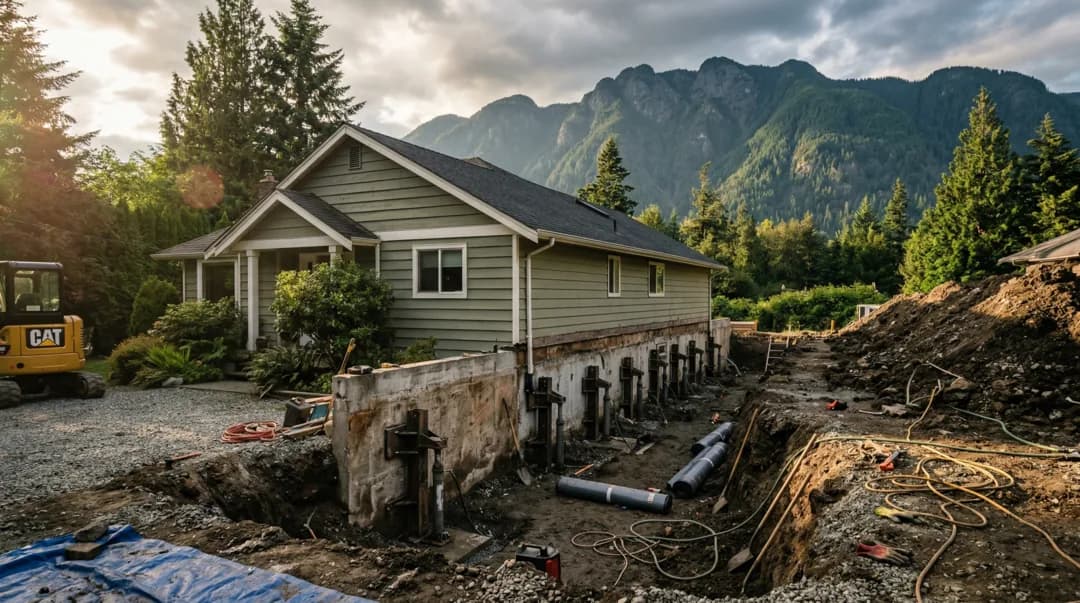
Why Foundations Settle in Chilliwack
Most foundation problems in Chilliwack come down to the ground the house sits on. The Fraser Valley is built on glacial and river-deposited soils: silts, sands, clays, and gravels laid down in layers that vary from one lot to the next. Some of these soils hold their shape under load for a century. Others compress, shift, or wash out when their moisture content changes. A house can be framed perfectly and still settle unevenly because one corner sits on a different soil layer than the rest.
The valley's climate does the rest of the damage. Summers here can run dry enough that clay-rich soils shrink and pull away from the concrete, leaving gaps around the foundation perimeter. We cover that mechanism in detail in our post on why foundations crack more in a dry summer than a wet winter. Then the fall and winter rains arrive, often in intense atmospheric river events, and the same soil takes on water quickly. Saturated soil expands and presses against foundation walls with hydrostatic pressure, while fast-moving groundwater can carry fine soil particles away from beneath footings and slabs. That cycle of shrinking, swelling, and washout is what produces most of the settlement we repair.
The common results look like this:
Differential settlement: one part of the foundation sinks faster than the rest, twisting the structure above it.
Voids under slabs: washed-out or compressed soil leaves empty space beneath concrete, and the slab eventually cracks and drops into it.
Hydrostatic pressure: saturated soil pushes laterally on basement walls, forcing water through pores and cracks and, in worse cases, bowing the wall itself.
Warning Signs Worth Taking Seriously
A settling foundation rarely announces itself in the basement first. The structure above is usually where the evidence shows up, because framing telegraphs movement long before concrete fails outright.
Inside the house, watch for doors that drag or stop latching, windows that jam in their frames, diagonal drywall cracks radiating from the corners of openings, and floors that slope or develop a soft dip. None of these guarantees a foundation problem on its own. A pattern of them, appearing together or getting worse over a season, is a strong signal that the structure is moving.
Outside, the classic indicator is stair-step cracking that follows the mortar joints in brick or block, since mortar gives way first when one side of a foundation drops. A chimney leaning away from the house is another, because chimneys often sit on their own shallow footing and settle independently. Gaps opening between the soil and the foundation in late summer are worth noting too: they show the soil is shrinking, and they give winter rain a direct path down the wall.
In the basement or crawlspace, persistent damp patches, efflorescence (the white mineral residue water leaves behind), musty smells, and mold growth all point to water moving through the concrete. Cracks themselves need interpretation rather than alarm. Width, direction, and location matter more than the mere fact of a crack, and we walk through how to read them in our guide to structural versus non-structural cracks.
Diagnosis Comes Before Any Repair Method
The single most important step in foundation repair is figuring out what the ground is actually doing before choosing a fix. Settlement, heave, and simple surface deterioration can produce similar-looking symptoms and need completely different repairs. A slab that dropped because of a void needs the void filled and the soil stabilized. A wall bowing under hydrostatic pressure needs the water managed first. A hairline shrinkage crack may need nothing more than sealing.
This is also why repair order matters as much as repair choice. Lifting a slab before correcting the drainage that undermined it just schedules the same failure for a few years later. On every project we address the cause, usually water, before the symptom. We wrote about this sequencing logic in why the order of repairs matters as much as the repairs themselves.
A proper assessment looks at the whole picture: where the water goes when it rains, what the soil is doing seasonally, how the cracks are oriented, and whether movement is ongoing or historical. Monitoring a crack over weeks can be more valuable than any single inspection, because it separates a foundation that moved once from one that is still moving.
How We Repair a Settling Foundation
For most settlement in the Fraser Valley, our primary tool is high-density polyurethane foam injection. The process is straightforward. Small holes, about the diameter of a dime, are drilled through the affected concrete. A two-part polymer is injected through them into the soil below, where it expands into rigid foam. That expansion does two jobs at once: it fills the voids that let the concrete drop, and it compacts and densifies the loose soil around it, increasing the ground's bearing capacity. Injected in controlled passes, the foam generates enough lift to raise a slab back toward level with precision measured in millimetres.
The material itself suits this climate. Cured polyurethane is closed-cell and hydrophobic, so it does not absorb water, soften, or wash out the way soil fills and cement slurries can. That matters in a region where the ground is soaked for half the year. The older alternative, mudjacking, pumps a heavy cement-and-soil slurry under the slab; the added weight can overload the same weak soil that caused the problem, which is why we do not use it.
Foam is not the answer to everything, and a contractor who claims one method fixes every foundation is worth questioning. Deep or ongoing settlement under footings can call for underpinning with piers that transfer the load to competent soil below. Bowing basement walls may need structural reinforcement before anything else. Active water intrusion usually means exterior grading, drainage, or interior water management alongside the structural work. Cracks that no longer move get injected and sealed. Full foundation replacement, the outcome homeowners fear most, is genuinely rare; it is reserved for concrete that has deteriorated beyond repair, not for a house that has merely settled.
What Drives the Cost of Foundation Repair
Every foundation quote reflects a few variables, and understanding them makes estimates easier to compare. Severity is the biggest one: a slab with a small void under one corner is a quick job, while a foundation with ongoing differential settlement across its footprint is not. Extent matters in the same way, since stabilizing one section of concrete takes far less material and time than treating a full perimeter. Access plays a role, because a tight crawlspace or finished basement takes more care than an open garage slab. And the method itself matters, since injection work prices very differently from excavation or underpinning.
The one pattern that holds across all of it: early repairs cost less. Settlement compounds. A slab that drops a few millimetres this year stresses plumbing, framing, and finishes as it goes, and each season of movement adds secondary damage to the eventual scope. Acting on early signs is consistently the cheaper path.
What a Repair Project Actually Looks Like
Foundation repair has a reputation for wrecked lawns and week-long disruption that modern methods no longer deserve. A typical injection project starts with an assessment and elevation measurements, so the lift can be planned rather than guessed. The work itself usually takes hours, not days. Equipment stays compact, materials travel through a hose rather than a wheelbarrow, and landscaping stays intact because nothing is excavated. The foam reaches most of its strength within minutes of injection, so a repaired slab can typically take normal traffic the same day. Injection holes are patched with colour-matched cement and are hard to spot once cured.
Underpinning and drainage work are more involved, but even there, a clear scope and a proper diagnosis keep projects tight. The expensive, disruptive foundation jobs are almost always the ones where the cause was ignored until the symptoms became structural.
Keeping a Repaired Foundation Stable
Once a foundation is stabilized, keeping it that way is mostly about water management, and most of it is inexpensive. Downspouts should discharge well away from the foundation rather than dumping at the wall. Grading should slope away from the house on every side, so rain moves off rather than pooling against the concrete. Gutters need to be clear before the fall storms arrive, because an overflowing gutter concentrates a roof's worth of water exactly where it does the most harm. In a region that swings between drought and deluge the way the Fraser Valley does, these basics do more to protect a foundation than any product on the market.
It also pays to keep an eye on the concrete itself. A quick walk around the house at the change of each season, checking for new cracks, widening gaps at the soil line, or damp patches after heavy rain, catches most problems while they are still small. Photographing a crack with a tape measure beside it takes a minute and creates a record that makes any future assessment faster and more accurate. Movement that shows up in those photos is worth a call; stability over several seasons is the reassurance most homeowners are actually looking for.
For homes with a history of settlement, planning around the seasons helps too. Summer droughts shrink the soil and winter rains swell it, so the shoulder seasons are when a foundation is under the least stress and when repairs and drainage improvements are easiest to schedule. Waiting until water is actively coming through a wall in December narrows the options and raises the urgency.
Frequently Asked Questions
How do I know if my foundation problem is serious?
Look for patterns and change. A single hairline crack that has looked the same for years is rarely urgent. Multiple symptoms appearing together, cracks that widen or lengthen over a season, doors that progressively stop closing, or any horizontal cracking in a basement wall deserve a professional assessment promptly.
How long does polyurethane foam injection last?
Cured polyurethane is inert, rigid, and does not absorb water, so it does not degrade the way soil fills do. When the underlying cause of movement, usually drainage, is corrected at the same time, an injection repair is designed to be permanent.
Will the repair damage my landscaping or driveway?
Injection work is minimally invasive. The holes are about the size of a dime, equipment is compact, and no excavation is needed, so lawns, gardens, and hardscaping stay as they are. Underpinning or exterior drainage work involves digging, and we scope exactly where before any work starts.
Should I fix foundation issues before renovating or selling?
Yes. Renovating over a moving foundation puts new finishes on a structure that is still shifting, and the cracks come back. For a sale, an unaddressed foundation issue becomes a negotiating lever for the buyer; a documented, professionally completed repair is far easier to stand behind.
What time of year is best for foundation repair in the Fraser Valley?
Injection work happens year-round. Assessment is often most revealing in late summer and early fall, when soils are at their driest and settlement is most visible, and completing repairs before the winter rains means the foundation faces the wet season already stabilized.
If your home is showing signs of settlement, do not wait for them to escalate. Contact Black Birch Contracting to schedule a foundation assessment anywhere in Chilliwack and the Fraser Valley, and get a clear diagnosis before you commit to any repair.