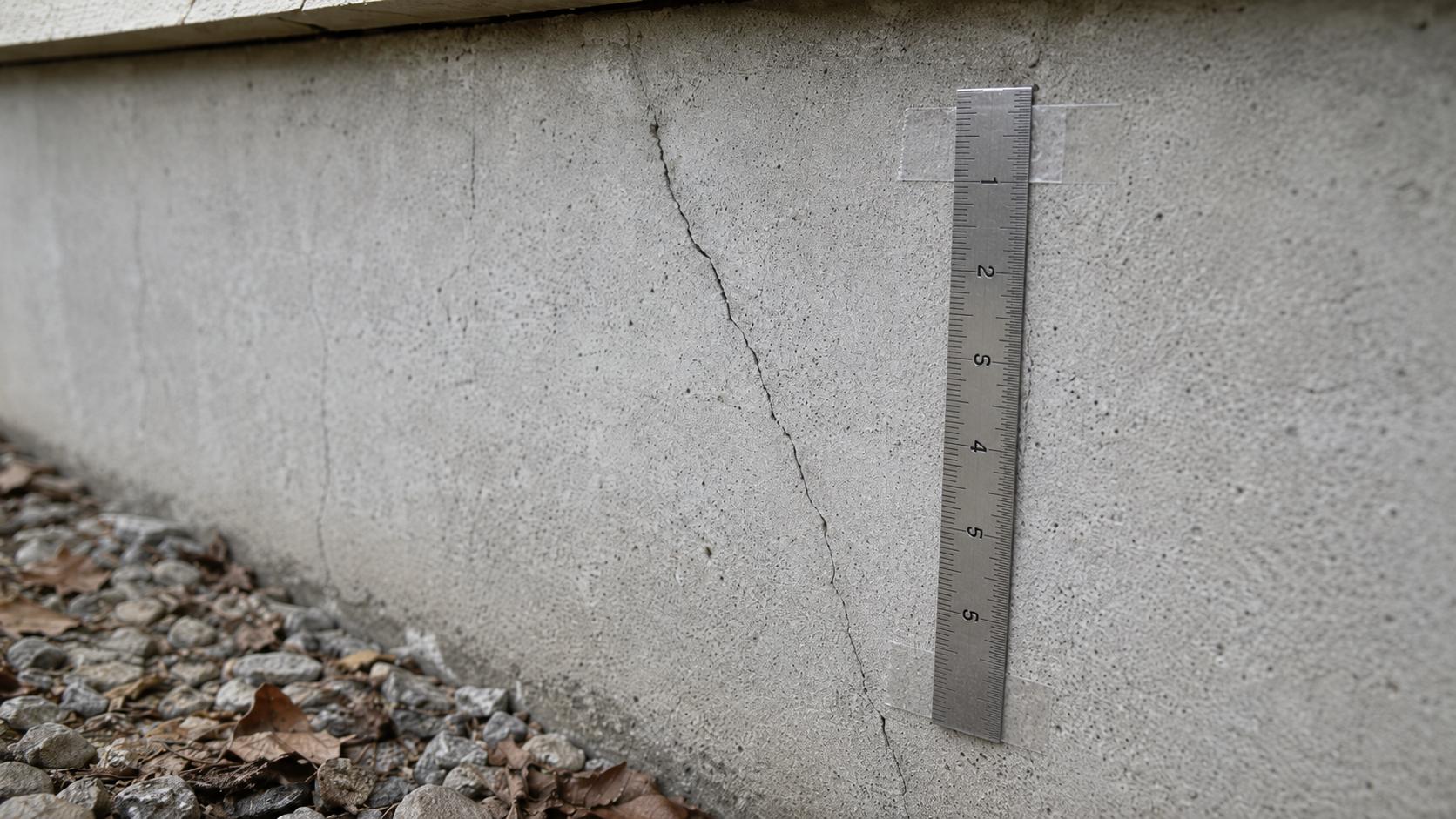
Finding a crack in your foundation can make your stomach drop. Before you pick up the phone or grab a tube of sealant, though, the smartest move is to pause and ask one question: is this crack actually moving, or has it been sitting there unchanged for years? In the Fraser Valley, where clay-heavy soils and big seasonal swings in moisture put real stress on concrete, monitoring a crack properly before committing to a repair can save you thousands of dollars and keep you from fixing something that was never a problem.
Why One Look Is Never Enough
A single visual check tells you almost nothing. It's like taking someone's temperature once and trying to diagnose an illness. The real question isn't whether the crack exists, but whether it's active or stable. A stable crack may have formed during normal concrete curing or from a one-time settlement event years ago, then simply stopped. An active crack is progressing, widening, or shifting because of ongoing forces beneath or around your foundation, such as expansive clay soils, hydrostatic pressure, or shifting loads. Only systematic observation over a defined timeframe can tell the two apart.
Crack direction and width do give useful clues, and you can learn more about what crack width, direction, and location indicate, but visual assessment is just one piece of the puzzle. Two cracks that look identical can have completely different causes and completely different trajectories. Repairing an active crack without understanding its cause will likely fail: the ongoing movement simply re-opens the repair or pushes the crack to a new location nearby. That is why the active versus stable question determines urgency, drives the choice of repair method, and decides whether you're spending money wisely or throwing it away. Monitoring isn't doing nothing. It's doing the right thing first.
Tools for Measuring Crack Movement
There's a measurement method for every budget and skill level. The pencil-and-ruler method is about as simple as it gets: draw two short lines perpendicular to the crack at defined reference points, measure the gap between them with a ruler or calipers, record the date and reading, and repeat every few weeks. Paint pen reference marks directly on the concrete, with the date written beside each mark, work the same way. A crack telltale marker is another affordable option. Apply a small bridge of plaster or gypsum across the crack; if the crack moves, the brittle bridge fractures or shifts visibly. Telltales confirm that movement has occurred, though they won't tell you how much or in which direction.
Professional-grade tools give you actual numbers. A calibrated crack comparator card is a transparent overlay you hold against the crack to read its width precisely. Crack displacement indicators, or CDIs, go further: these plastic devices mount across the crack face and measure both widening and lateral shear using crosshair grids. The difference comes down to resolution. Telltales confirm movement; CDIs tell you how much and in which direction. Whichever tool you use, measure at multiple points along the crack's length, not just the widest spot, because cracks don't always behave the same way from one end to the other. Photos are a useful complement to physical measurements, but on their own they can't replace real readings. Combining both gives you the most reliable monitoring program you can realistically put together.
Building a Simple Documentation System
Tracking a crack consistently over time is what turns individual observations into meaningful trend data. Each log entry should record the date, ambient temperature, recent weather, the exact measurement location, the width reading, and any visible efflorescence (white mineral deposits) or spalling (flaking concrete). Without those details, you're left guessing whether a change is real or just the result of different conditions on different days. A simple spreadsheet or a notebook works perfectly.
Consistency is everything. Measure at the same locations, with the same tool, at the same time of day. When photographing, include a reference object like a coin or small ruler in the frame; without a scale reference, photos taken weeks apart are almost impossible to compare accurately. Temperature alone can shift readings, so controlling what you can control makes a real difference.
Plan on a minimum observation window of 60 to 90 days, which gives you enough data points to identify a real trend rather than reacting to one measurement. And keep seasonal baselines in mind: readings taken in summer versus winter will naturally differ because of thermal expansion and soil moisture changes, not necessarily true structural movement. Organized records also pay off the moment you bring in a structural engineer or contractor. Instead of starting from scratch, they can review months of your data and quickly determine whether the crack is stable or progressing. Your log turns a subjective conversation ("it looks bigger to me") into an objective one backed by dates and measurements.
How Fraser Valley Conditions Affect the Monitoring Window
Monitoring a crack here isn't the same as tracking one in a dry, stable climate. The Fraser Valley swings between wet winters and surprisingly dry summers, and that cycle has a direct effect on the clay-rich soils under many local homes. These expansive soils swell when they absorb moisture and shrink as they dry out. By late summer, shrinkage can pull soil away from foundations and make cracks look wider than they did in spring. Then the fall rains return, the soil expands and pushes back in, and the same cracks partially close. You can read more about the seasonal soil conditions that drive crack movement in our detailed guide.
That's why an effective monitoring window should span at least one full seasonal transition, ideally from dry summer into wet fall or from wet spring into summer. Seasonal movement that reverses itself, widening in summer and closing in winter by roughly the same amount, typically signals a stable, predictable thermal pattern. Progressive movement that only goes in one direction, getting wider without ever closing back, points to a structural concern that warrants a proper assessment.
One exception: high groundwater in spring increases hydrostatic pressure against basement walls and can accelerate crack growth over a relatively short period. If you install a crack gauge and notice rapid or significant changes within just a few weeks, don't wait for a full seasonal cycle. Rapid change is your signal to move from monitoring to action.
Reading the Signs in Your Data
Small fluctuations in readings are normal, particularly with seasonal temperature swings. That said, measurable widening of more than 1mm over your monitoring period is a meaningful signal worth a closer look. So is any lateral displacement, sometimes called shear, where one side of the crack shifts vertically relative to the other, and any extension of the crack's total length. When your measurements show widening and shear happening at the same time, that combination is considerably more serious than widening alone, because it suggests the foundation is being stressed in multiple directions at once.
Pattern matters as much as magnitude. A crack that opens evenly along its full length may simply be responding to thermal expansion and contraction, which is often benign. A crack that grows wider at one end while staying tight at the other can indicate structural rotation or active settlement, and deserves prompt attention. So does progression that moves consistently in one direction across multiple readings.
Look beyond the crack itself, too. Doors or windows that suddenly stick or won't latch, or new cracks appearing parallel to or branching off the one you're watching, help confirm what your measurements are already suggesting. And monitoring doesn't always reveal bad news. Plenty of cracks stay completely stable for years, and having the data to prove it is useful for your own peace of mind and if you ever need to demonstrate it to a buyer or insurer.
When to Call In a Professional
If your data is ambiguous, or clearly trending in a concerning direction, it's time to arrange a structural crack assessment with a qualified professional. Worth keeping in mind: identical-looking cracks can require very different repairs, so having an expert interpret your monitoring data means you get the right fix, not just any fix. All that careful documentation gives a professional exactly what they need to make an informed call.
Frequently Asked Questions
How do I know if my foundation crack is active or stable?
The only reliable way to tell is through systematic monitoring over time, not a single visual inspection. A stable crack will show no change in width, length, or direction across multiple measurements taken over weeks or months. An active crack will show measurable progression, shifting, or widening, particularly during seasonal transitions when soil moisture and temperature changes put extra stress on your foundation.
How long should I monitor a foundation crack before deciding to repair it?
Most professionals recommend monitoring a crack through at least one full seasonal cycle. Fraser Valley conditions, including clay soils that swell with rain and concrete that contracts with freeze-thaw swings, can cause natural fluctuations that look alarming in one season but stabilize in another. A minimum monitoring period of three to six months gives you meaningful data to work with. That said, certain signs, such as rapid widening, horizontal cracking, or visible structural distortion, warrant skipping monitoring entirely and calling a professional right away.
What tools can I use to measure foundation crack movement at home?
A crack gauge is the most accurate tool for tracking changes in crack width over time, giving you consistent, comparable readings across multiple check-ins. If you want something simpler, pencil marks on either side of the crack with a date written beside them work fine as a starting point. Combining that with dated, close-up photos taken from the same angle and distance builds a documentation record that you, or a contractor reviewing it later, can actually use.
Can I just seal my foundation crack right away instead of monitoring it?
Sealing an active crack without understanding its cause will likely fail. Ongoing movement will re-open the repair or push the crack to a new location nearby. Monitoring first helps confirm whether the crack is stable enough to seal successfully, or whether the underlying issue needs to be addressed before any repair will hold. A few months of observation can easily save you from paying for the same repair twice.
Do Fraser Valley soil and climate conditions make foundation crack monitoring more important?
Yes, significantly. Clay-heavy soils common throughout the Fraser Valley expand when wet and contract when dry, creating seasonal movement patterns that can make a crack look worse in winter and better in summer, or vice versa. Temperature swings between warm summers and cold winters add further stress to concrete. Because of these regional factors, a structural crack assessment done in one season may tell a very different story than one done six months later. That is why multi-season monitoring matters more here than it does in more stable climates.
When should I stop monitoring and call a professional?
If you notice a crack that is widening rapidly, running horizontally across a concrete block or poured wall, or appearing alongside bowing, leaning, or doors and windows that suddenly stick, contact a professional immediately rather than continuing to monitor. Likewise, if your monitoring data shows consistent progression over several months with no signs of stabilizing, that pattern alone is reason enough to bring in an expert for a full assessment. Monitoring is a smart first step, but it is not a substitute for professional evaluation when warning signs are stacking up.
Knowing whether your foundation crack is active or stable is the most important thing to figure out before spending a dollar on repairs. Getting that answer right requires proper monitoring, documentation, and some familiarity with local conditions. If you have noticed a crack and are not sure what to do next, reach out to our team at Black Birch Contracting for honest guidance tailored to Fraser Valley conditions.