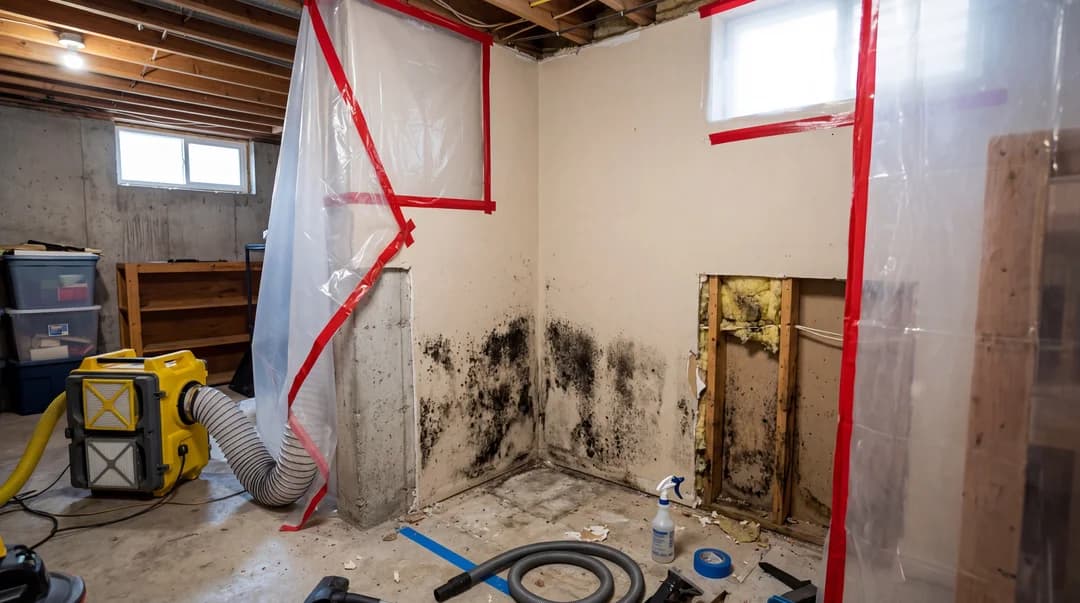
Fuzzy dark patches on a basement wall, or a musty smell drifting up from a crawlspace, usually send people looking for someone to get rid of it. Before making that call it is worth knowing that mold removal and mold remediation are not the same service. Removal deals with the growth you can see. Remediation deals with the water that put it there. In a climate as wet as ours, that difference decides whether the problem is solved or simply postponed.
Visible Mold Is the Symptom
Mold is not a cleanliness problem with a moisture side effect. It is a moisture problem with a visible byproduct. Spores are present in every building and only become a colony when they find sustained dampness and something organic to feed on. The patch on the wall is evidence, not cause.
Cleaning or coating that patch changes what you see without changing the condition that produced it. If the cavity behind it is still taking on water, growth returns, usually in the same place and often within a few months. It is the same pattern as any other repair that looks finished while the underlying problem keeps running.
Remediation is the wider job: find the moisture pathway, contain the work area so spores are not spread through the rest of the house, take out what cannot be salvaged, correct the building condition that let the water in, then verify before closing anything up.
Why a Wet Coast Raises the Standard
The Fraser Valley is one of the wettest inhabited parts of the country, and our temperatures stay mild enough that mold growth is rarely held back for long. Persistent rain supplies the water and the climate does the rest. Given a damp cavity, colonization can begin within a couple of days.
That combination changes what counts as an adequate repair. In a dry climate a cleanup plus a modest fix can hold, because ambient humidity alone will not sustain regrowth. Here, indoor humidity and ground moisture will keep a colony going on their own. The widely accepted target for indoor relative humidity is 30 to 50 percent, and holding a house in that range takes deliberate ventilation and moisture control rather than good luck.
Where the Water Is Actually Coming From
Most recurring mold in this region traces back to one of three building conditions, and none of them are fixed by cleaning.
Crawlspace moisture. A high water table and exposed soil under the floor mean ground moisture evaporates upward into floor assemblies and the base of walls more or less continuously. A sealed, properly lapped vapour barrier across the crawlspace floor is what interrupts that. When the barrier is torn, incomplete, or absent, the crawlspace behaves like a humidifier running under the house year round, and no amount of surface work upstairs will change it.
Drainage and foundation water. When grade slopes toward the building, or perimeter drains are silted up or undersized, rainwater collects against below-grade walls and works through cracks, cold joints, and porous concrete. This is a site water problem presenting as an indoor mold problem, and it gets solved outside.
Envelope leaks. Failed flashing, a poorly detailed window head, deteriorated sealant, or a cladding transition that was never detailed correctly can admit a small, steady amount of water into a wall cavity. These leaks are slow enough to go unnoticed and steady enough to sustain growth behind finishes for a long time. What sustained Fraser Valley rain does to a house covers how those paths open up.
What a Real Remediation Scope Involves
Containment before anything is disturbed. Cutting into contaminated material without isolating the area is how a localized problem becomes a whole-house problem. That means poly sheeting sealing off the work zone, negative air with HEPA filtration so the space draws in rather than pushes out, covered HVAC openings, and proper protection for anyone working inside. Containment should scale with the contamination, but even a small job needs the airflow thought through rather than assumed.
Deciding what gets cleaned and what gets removed. Three things drive that call: how much area is affected, how porous the material is, and whether it is still structurally sound. Non-porous surfaces like sealed concrete, metal, or glass can usually be cleaned. Porous materials are different. Once growth is established through drywall, batt insulation, or bare wood, cleaning the face of it leaves the colony in the substrate. Framing or sheathing that has been wet long enough to soften or lose section is a repair question, not a cleaning question.
Water first, always. The moisture source has to be corrected before or during the work, never after. Remediating first and repairing the leak later puts new material into the same wet cavity that destroyed the old material. It is a specific case of a general rule about why the sequence of repairs matters as much as the repairs themselves.
Where Testing Fits
Air sampling and lab identification have a place, but they answer a narrower question than most people expect. A spore count describes conditions at the moment of sampling. It does not tell you where the water is coming from, and the species involved rarely changes the repair: material that is wet and colonized comes out, and the source gets fixed, whichever organism happens to be growing on it.
Testing earns its cost in specific situations. Confirming whether a suspected problem exists behind an intact finish. Establishing a baseline where an occupant's health is a concern. Documenting conditions for an insurance claim or a property sale. Verifying afterward that a completed job actually cleared. Paying for a full panel before anyone has gone looking for the leak usually buys information you cannot act on.
Telling a Real Proposal From a Cosmetic One
Quotes for this work vary enormously, and the spread usually reflects genuinely different scopes rather than different margins. A proposal that names only treatment, spraying, or coating is a cosmetic scope no matter what it costs.
A real proposal identifies the suspected moisture source and says how it will be confirmed. It specifies containment. It lists which materials come out and what replaces them. It includes the actual repair, whether that is drainage, a vapour barrier, flashing, or foundation work. And it says how the work gets verified before anything is closed up.
Three questions separate the two quickly. How will you establish where the water is coming from before work starts? What repairs to the source are inside your price? How will you confirm the cavity is dry before you close the wall? Anyone working from a moisture-first mindset will have ready answers. Red flags that a contractor is fixing the symptom rather than the source goes further on that distinction.
There is also a coordination argument for keeping it under one scope. When a cleaning company treats the mold and a separate trade is meant to handle the drainage or the envelope later, the moisture repair is the piece that tends to get deferred. It is also the piece that determines whether any of it holds.
Frequently Asked Questions
What is the difference between mold remediation and mold removal?
Mold removal targets visible mold growth by cleaning or cutting away what you can see on surfaces. Mold remediation goes further by identifying and correcting the underlying moisture source mold remediation addresses, whether that's foundation cracks, failed waterproofing, or crawlspace humidity. Without addressing the root cause, mold almost always comes back.
Why does mold keep coming back after I clean it?
If mold returns after cleaning, the moisture source feeding it hasn't been fixed. Common culprits in Fraser Valley homes include envelope leaks, failed flashing, inadequate vapour barriers, and crawlspace drainage issues. Applying antimicrobial coatings or paint without repairing those underlying conditions pretty much guarantees the mold will reappear.
Do I need a mold specialist or a general contractor for mold remediation?
It depends on what's causing the mold. If the problem stems from structural issues like foundation cracks, a compromised building envelope, or damaged waterproofing, a general contractor with experience in structural repair is often better suited to deliver a lasting fix. A cleaning crew can remove visible mold, but only structural repairs can eliminate the moisture conditions that produce it.
How does Fraser Valley's climate affect mold growth in homes?
The Fraser Valley receives over 1,500 millimeters of rain annually, and mild temperatures mean mold rarely goes dormant. Mold colonization can begin within 24 to 48 hours of a moisture intrusion event, making this one of the most persistent regions in Canada for mold-related home issues. Finding and eliminating the moisture source is not optional here. It is genuinely the only approach that works long term.
What does a proper mold remediation process include?
A thorough mold remediation process includes a full assessment to locate the moisture source, containment measures to prevent spore spread during work, removal of affected materials where necessary, and repair of the structural or building envelope issue causing moisture intrusion. Skipping any of these steps, particularly the moisture correction phase, leaves the problem incomplete regardless of how clean the surface looks.
How can I tell if a contractor is offering real remediation or just a surface cleanup?
A contractor offering genuine mold remediation in Fraser Valley will ask about water intrusion history, inspect wall cavities, drainage, foundation interfaces, and vapour barriers, and propose repairs to the moisture source rather than simply treating what's visible. If the only proposal involves cleaning, spraying, or painting without any structural or waterproofing work, the solution is probably temporary.
Mold is rarely just a surface problem, and in a climate as wet as the Fraser Valley, treating it like one leads to the same issue showing up again and again. If you're dealing with recurring mold or suspect a deeper moisture problem in your home, reach out to our team at Black Birch Contracting to get an honest assessment and a plan that actually solves the problem at its source.