
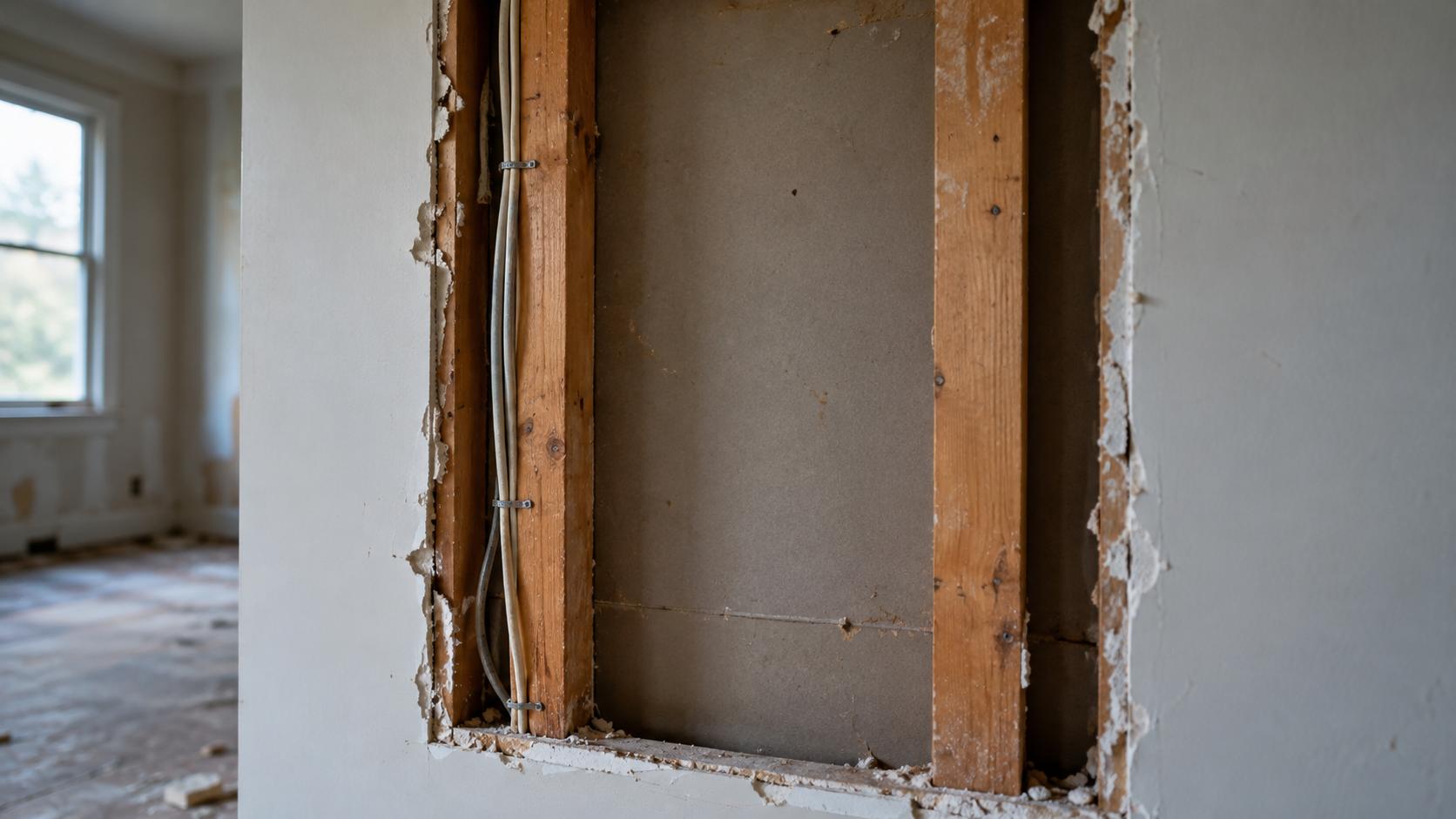
Noise through a finished wall usually comes down to an empty cavity: a hollow space between two sheets of drywall that resonates like a drum and leaks sound through every gap around outlets and trim. Filling that cavity with injected polyurethane foam, through holes about the size of a dime, can cut that noise without opening the wall. How much it helps depends on four things: the kind of noise you are dealing with, what is already inside the wall, the foam that goes in, and how carefully it is injected.
Why Hollow Walls Carry Sound
Most interior walls are two layers of drywall on wood studs with nothing between them. Sound striking one face sets the drywall vibrating, and the air in the empty bay passes that energy to the other face, amplifying some frequencies on the way. Sound also takes the easy route: gaps around electrical boxes, under baseboards and along the top plate let airborne noise leak straight through. A wall can be solid and still noisy if air moves through it.
This is why foam panels fixed to the surface rarely solve a neighbour problem. Panels absorb echo inside a room. They do very little to stop sound passing through the wall behind them, because they add almost no mass and seal nothing.
What Injection Foam Changes
Filling the bay does two useful things. It damps the resonance of the empty cavity, and it seals the air paths inside the wall that sound leaks through. For airborne noise in the mid and upper range, such as voices, a television or a phone call next door, the difference is usually clear: speech that was easy to follow tends to become a muffled murmur.
It does less for bass and impact noise. Low frequencies, footsteps and closing doors travel through the studs themselves, which connect the drywall on both sides. Foam cannot break that connection. Fixing structure-borne noise properly means decoupling the wall with resilient channel or a separate stud wall, and that requires opening it. We say this up front because it decides whether injection is the right fix or only the least disruptive one.
Checking the Wall First
Before anything is injected, we confirm what is actually inside. A small inspection hole and a scope show whether the bay is empty, already insulated, or interrupted by horizontal blocking, pipes or ductwork. A wall that already holds batt insulation will gain little from foam, and that is worth knowing before spending anything.
Wiring matters too. Foam flows around cables, but the drill must not find them, and some older wiring should be assessed before it is enclosed. Walls between units need an extra step. Party walls in townhouses, duplexes and row homes are usually fire separations, and anything placed inside them has to respect that rating, which can mean checking with the strata or the municipality first.
Choosing the Foam
Not every polyurethane suits a closed wall. Fast-rise foams made for open framing, and the single-component cans sold for sealing gaps, can expand hard enough to push drywall off the studs, or fail to cure properly inside a dry cavity. Retrofit work calls for a slow-rise injection foam that flows to the bottom of the bay while still liquid and then expands gently. That controlled expansion comes from the same chemistry we explain in how polyfoam grout expands, seals and cures.
Within that category, a softer open-cell formula generally suits acoustic work better than a rigid closed-cell one. Open cells absorb and damp sound energy, while a very rigid fill can stiffen the wall and pass vibration through more readily.
Injecting Without Bowing Drywall
The work is simple in outline. Each bay is located and marked, small injection holes are drilled, usually one low and one higher on the wall, and the foam goes in slowly, in stages on taller walls so each lift can set before the next. Small relief holes at the top let air escape instead of pressurizing the cavity. Once the foam cures, the excess is trimmed, the holes are patched and the wall is repainted. The room generally stays usable throughout.
The risk sits almost entirely in the pace and the product. Overfilling, or using a foam that expands too quickly, bows the drywall into a visible hump that then needs repair. That is the main reason we do not recommend hardware-store kits for whole walls: holding the mix ratio, temperature and fill rate steady across dozens of bays is where they fall short. Ventilation during curing matters as well, since curing polyurethane gives off fumes that should be exhausted outside.
If you are comparing quotes for this work, ask each contractor how they check the inside of the wall before injecting and which foam they use. The questions worth asking any contractor before you sign apply here too.
Frequently Asked Questions
How much quieter will a wall be after foam injection?
For voices and television coming through an empty wall, the improvement is usually noticeable, with speech becoming muffled rather than clear. Bass and footsteps improve less, because that sound travels through the framing. We look at the wall and the type of noise first so the expectation is set before any work starts.
Will injecting foam damage my drywall?
Not when a slow-rise injection foam is used, relief holes are drilled and tall bays are filled in stages. Bowing happens when a fast-expanding product goes into a closed cavity or a bay is overfilled.
Can I do this myself with a spray foam kit?
A kit can seal a few gaps, but whole-wall injection is hard to control at that scale. Uneven fill leaves voids that let sound through, and overfilling can bow the drywall. For finished living spaces we recommend professional injection.
Does it work on a wall shared with a neighbour?
Often, yes, as long as the wall is checked first. Because walls between units are usually fire separations, we confirm what is inside the wall and what is permitted before injecting anything.
Do we need to move out while the work is done?
No. Injection works through small holes, so there is no demolition dust or debris, and the foam cures quickly. The area is ventilated during curing, and patching and paint finish the job.
Is foam injection better than acoustic panels?
They do different jobs. Panels reduce echo inside a room, while injection reduces sound passing through the wall. For noise from next door, injection addresses the problem where it actually is.
If noise through a wall is a problem in your Fraser Valley home, contact Black Birch Contracting. We will look at what is inside the wall and tell you plainly what injection can and cannot fix.