
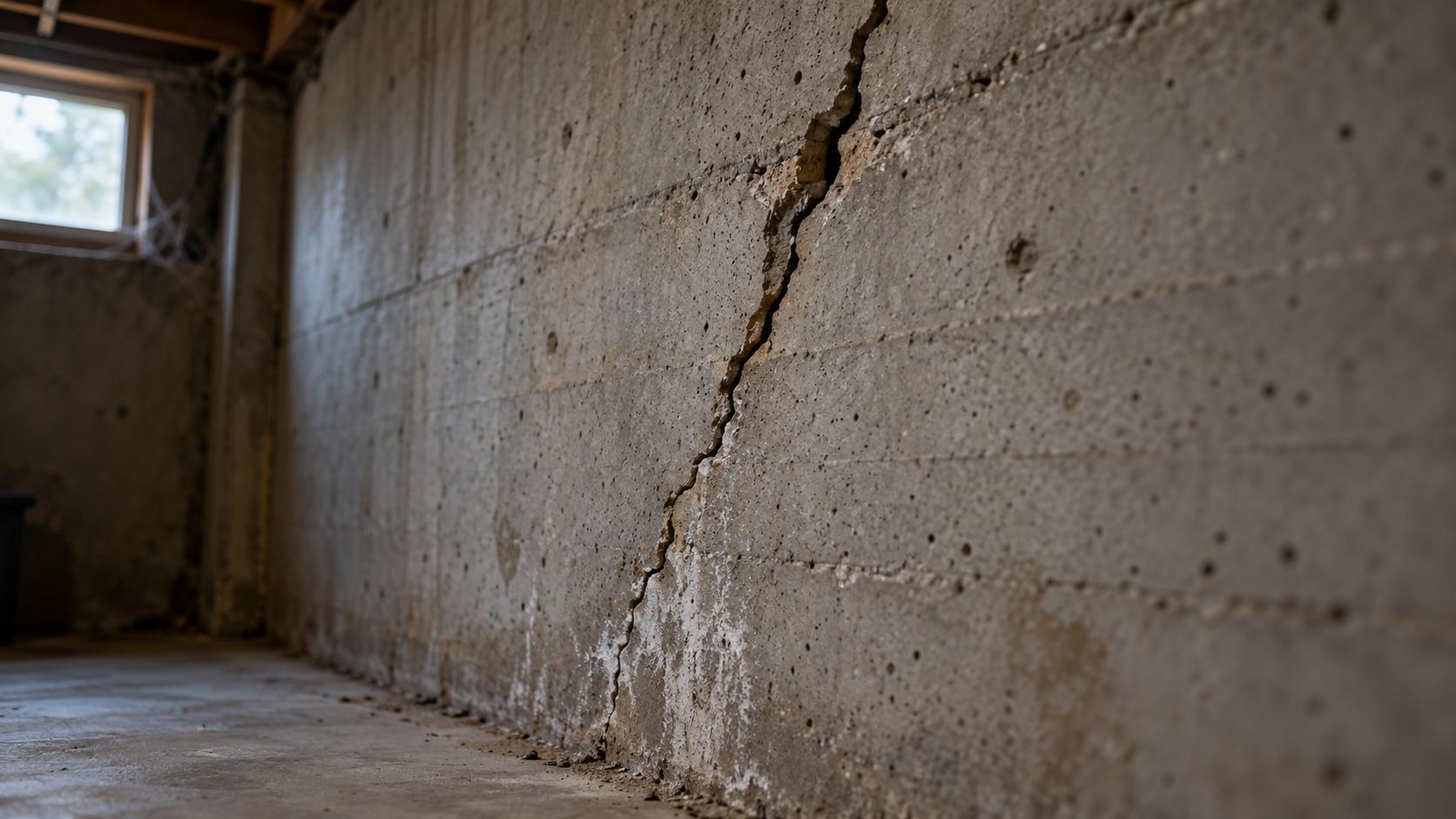
Most foundations crack, and most of those cracks are harmless shrinkage from the concrete curing. The ones that matter are caused by the building, or the soil under it, moving. Telling them apart comes down to four things you can check yourself: the crack's direction, its width, where it sits, and whether it is still moving. How deep the crack goes and what kind of wall it is in then decide how it should be repaired.
Why Concrete Cracks
Concrete shrinks as it cures, and that alone produces fine cracks in the first weeks and months. They are shallow and usually stable. Structural cracks come later, from forces acting on the finished foundation: soil settling unevenly under a footing, saturated ground pushing sideways on a basement wall, or clay swelling in wet months and shrinking in dry ones. In the Fraser Valley, wet winters, dry summers and freeze-thaw cycles keep those forces working all year, and a foundation here can crack as readily in a dry summer as in a wet winter.
Crack Direction
Direction is the quickest filter.
- Vertical: usually shrinkage, or a small amount of settlement spread evenly along the wall. Worth watching for widening and water, but rarely urgent.
- Horizontal: the most serious pattern on a basement wall. It usually means soil or water pressure is pushing the wall inward, and it tends to widen as the wall bows.
- Diagonal: usually differential settlement, with one part of the foundation dropping faster than another. Short diagonals off window and door corners are often just stress at the opening.
- Stair-step: the block-wall version, following the mortar joints. Even, stable steps suggest old settlement. Steps that widen as they climb suggest active pressure.
Crack Width and Offset
Width helps, but only alongside direction. Hairline cracks under about 0.3 mm are typically shrinkage. Anything wider than about 3 mm, roughly 1/8 inch, deserves a professional look whatever its direction. In between, behaviour matters more than size: a 2 mm horizontal crack in a below-grade wall is more concerning than a wider shrinkage crack in a basement slab, because different forces made them.
Offset matters more than width. If one side of the crack sits higher or further out than the other, the concrete has physically shifted, and that is structural movement at any width.
Crack Location
The same crack means different things in different places. A horizontal crack at mid-height of a wall is a bowing warning, while a vertical crack near a corner is usually shrinkage. Cracks at beam pockets, posts and other points carrying concentrated load deserve more concern than the same crack in an open stretch of wall. Cracks where the wall meets the footing are easy to dismiss but can signal footing movement or become a path for water.
Slabs follow their own rules. A web of fine lines across a basement floor is normal curing shrinkage. A single wide crack running wall to wall, especially with one side lower, points to settlement beneath it.
Active and Dormant Cracks
A crack that has stopped moving and one that is still opening can look identical on any given day, and they need different repairs. Mark both ends with a pencil and the date, or photograph it with a ruler beside it, and check it monthly through at least one wet season and one dry one. Cracks that open in winter and close in summer are not reassuring: they mean the soil is active and the foundation is responding to it. The methods are covered in more detail in tracking whether a foundation crack is moving.
Crack Depth and Wall Type
Depth separates surface crazing, which stays in the top layer, from partial-depth cracks, which can deepen with freeze-thaw, and through-wall cracks, which cross the full thickness and are the likeliest to leak. Wall type changes the reading too. Poured concrete spreads stress evenly, so a crack there usually points to one identifiable force. Block walls crack along their mortar joints, and a horizontal crack in block is a strong sign the wall is bowing.
Matching the Repair to the Crack
This is where two similar-looking cracks part ways. A dormant shrinkage crack needs sealing at most, mainly to keep water out. A structural crack that is dry and has stopped moving suits epoxy injection, which bonds the wall back together. A crack that leaks or still moves with the seasons suits a flexible polyurethane injection that seals out water and tolerates slight movement, where rigid epoxy would simply crack again beside the repair. A horizontal crack from a bowing wall needs the wall stabilized, and settlement that is still under way may need underpinning.
Whatever the repair, the cause has to be dealt with too. Where water around the foundation is the driver, fixing the crack without fixing the drainage rarely holds. If a crack is one of several things that seem off, it is worth checking the wider signs of structural damage in a house alongside it.
Frequently Asked Questions
How can I tell if a foundation crack is structural?
Check direction, width, offset and movement. Horizontal cracks, cracks wider than about 3 mm, cracks where one side sits higher than the other, and cracks that keep widening all point to structural movement. Fine vertical cracks that stay the same size are usually shrinkage.
Are horizontal cracks worse than vertical ones?
Generally, yes. A horizontal crack in a basement wall usually means soil or water pressure is pushing the wall inward. Vertical hairline cracks more often come from curing shrinkage, though they still deserve watching for widening or leaks.
What does a stair-step crack in a block wall mean?
It follows the mortar joints and usually reflects settlement or sideways pressure. Even, stable steps often point to old movement that has stopped. Steps that are widening suggest the cause is still active and should be assessed.
Why does my crack open in winter and close in summer?
The soil around the foundation is swelling and shrinking with moisture, and the wall is moving with it. A crack that changes with the seasons is active, even if it looks small, and a rigid patch will not hold.
Can I seal a foundation crack myself?
Sealing a fine, dormant shrinkage crack to keep water out is reasonable. Sealing a structural or active crack hides the movement without stopping it, so the damage continues behind a clean surface. Work out what is causing the crack before choosing how to fill it.
What does foundation crack repair involve?
It depends on the diagnosis. Stable structural cracks are often injected with epoxy, leaking or moving cracks with flexible polyurethane, and bowing walls or ongoing settlement need stabilizing or underpinning. Drainage problems feeding the crack usually need fixing at the same time.
If you have a crack you are unsure about anywhere in the Fraser Valley, contact Black Birch Contracting for an assessment and a repair plan matched to what is actually causing it.